When comparing cordless electric floor scrubbers, the real choice is usually between a powered scrubber and a manual mop—not between two identical machines. A cordless scrubber spins or oscillates its brush to loosen grime, so it can reduce repetitive arm work and help with stubborn marks. A spin mop asks you to provide the scrubbing force, but it is cheaper, has no battery to manage, and works across a wider range of floors and messes.

Get cleaning gear delivered free with Prime
- Fast, free delivery on millions of items
- Prime Video, Amazon Music and more included
- Member-only deals all year
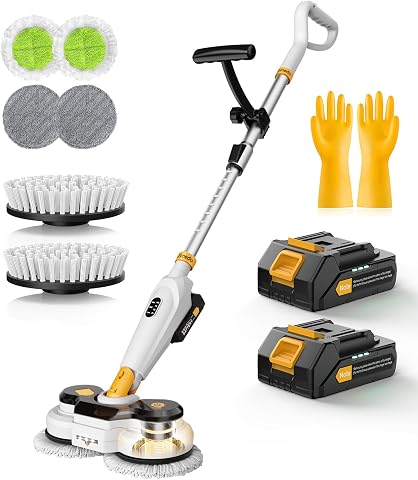
Qimedo M3 Cordless Electric Mop and Floor Scrubber
- ✔ Model: M3
- ✔ Motor speed modes: 400, 600, and 800 RPM
- ✔ Water tank: Removable, 450 ml
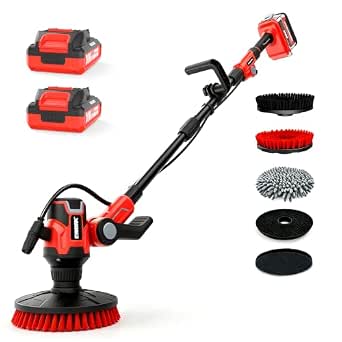
EWORK Cordless Electric Floor Scrubber with Water Feed
- ✔ Model: EK-DFS15A-2MR
- ✔ Motor: Brushless
- ✔ Voltage and batteries: 20V; two 2Ah batteries

VMAI Cordless Electric Floor Scrubber and Mop with Detachable Battery
- ✔ Motor: Dual-spin
- ✔ Battery: Detachable; spare battery sold separately
- ✔ Attachments: One pair of scrubbing brushes and two pairs of soft pads
The scrubber is the stronger fit for frequent cleaning, large areas, or users who want help with physical effort. The spin mop makes more sense for occasional mopping, tight budgets, and households that value simplicity over powered scrubbing. Models vary widely, so check brush type, runtime, weight, and floor-care instructions before buying either option.
At a Glance
| Criteria | Cordless electric floor scrubber | Manual spin mop | Winner |
|---|---|---|---|
| Scrubbing effort | Motorized brush supplies much of the repetitive scrubbing motion. | User supplies the pressure and movement; wringing systems can reduce hand contact with dirty water. | A |
| Stubborn grime | Brush action can help loosen dried or stuck-on residue; results depend on brush and cleaner. | Can scrub with added pressure, but takes more time and physical work. | A |
| Coverage and reach | Useful for open floor areas, though head shape and battery runtime limit coverage. | Bucket and mop are easy to move around; manual effort rises with area size. | Depends |
| Battery and readiness | Needs charging and may have limited runtime; cordless use avoids a power cord. | Ready whenever filled; no charging or runtime limit. | B |
| Floor compatibility | Best on floors approved by the manufacturer; brush and water settings matter. | Generally adaptable, provided the mop is used with the right moisture level and floor-safe cleaner. | B |
| Maintenance | Brushes, tanks, and the machine need rinsing, drying, and occasional replacement parts. | Mop head and bucket need washing and drying; fewer powered parts to maintain. | B |
| Upfront value | B |
Qimedo M3 Cordless Electric Mop and Floor Scrubber
The Qimedo M3 earns our top spot because it combines features that solve the everyday logistics of powered floor cleaning: a removable 450 ml tank, on-demand spray, three cleaning modes, and two rechargeable batteries. Rather than depending on a garden hose like the EWORK, it carries its water with it, making it more convenient for room-to-room mopping. Its 400, 600, and 800 RPM modes also give us more ways to adjust the cleaning action than the EWORK’s two-speed setup.The stated runtime of up to 420 minutes on low speed with two batteries is a notable planning detail, but it should be read narrowly. It is a low-speed claim, not a promise of that duration at the highest setting, and the supplied information does not describe how runtime changes across modes. A smart battery display helps us keep track of charge, while the LED can make it easier to see the immediate floor area. The 50-inch handle and 90-degree head adjustment add useful reach and positioning flexibility.Compared with the VMAI, Qimedo is the more self-contained choice for carrying cleaning solution and selecting a speed; VMAI instead emphasizes swivel steering, dual-spin motors, and a bundle of soft pads for sealed floors. Qimedo also has limits: it is not designed for tubs or immersion, and its spray control should not be held down for prolonged spraying. Choose it for mobile, routine floor cleaning rather than soaking tasks or a floor scrubber that can be submerged.
Pros:
- Three speed modes from 400 to 800 RPM allow more adjustment than EWORK’s two-speed setup.
- Removable 450 ml tank and targeted spray avoid the garden-hose dependency of EWORK.
- Two batteries and a battery display support charge planning; low-speed runtime is listed up to 420 minutes.
- A 50-inch handle, 90-degree head adjustment, and LED support practical reach and visibility.
Cons:
- Not intended for tub cleaning or immersion in water.
- The spray button should not be held for prolonged spraying.
- The stated runtime applies to low speed, so high-speed duration remains unclear.
Best for: Households that want a cordless, self-contained wet-cleaning tool with multiple speed choices, a water tank, and two included batteries.
Not ideal for: People who need a scrubber for tubs, immersion, continuous prolonged spraying, or a model whose high-speed runtime is clearly specified.
Bottom line: We recommend the Qimedo M3 as the most balanced self-contained pick, provided its immersion limits and low-speed-only runtime claim fit your expectations.
“We recommend the Qimedo M3 as the most balanced self-contained pick, provided its immersion limits and low-speed-only runtime claim fit your expectations.”
EWORK Cordless Electric Floor Scrubber with Water Feed
The EWORK Cordless Electric Floor Scrubber is our versatility pick because its four interchangeable heads make it the most task-flexible option in this lineup. A stiff brush, soft brush, chenille mop pad, and scouring pad give buyers distinct attachments for different cleaning approaches, instead of asking one brush to handle every surface. Its eight locking angles, from -15 to 90 degrees, also let the head sit in varied positions for floors, corners, and some wall-cleaning tasks. The telescopic handle extends from 45 to 59 inches, a wider adjustment range than the fixed 50-inch handle listed for Qimedo.Its defining difference is the standard garden-hose connection with handle-mounted water control. For cleaning that benefits from a continuing water supply, this is more direct than repeatedly refilling Qimedo’s 450 ml tank. That convenience comes with a clear setup cost: the hose must be available and positioned, so EWORK is less self-contained for carrying between rooms. Its two speeds, 200 and 400 RPM, are also lower than Qimedo’s listed 400-to-800 RPM range; buyers who specifically want a higher selectable speed should look at Qimedo instead.Two 20V 2Ah batteries are included, but no runtime estimate is supplied, so we cannot compare its working time directly with Qimedo’s low-speed claim. Brush-head IPX7 and motor-chamber IPX5 ratings support wet-cleaning use, but they do not erase the product’s need for sensible water handling. We would choose EWORK for attachment choice and hose-fed cleaning, not for buyers seeking a compact, tank-based mop or a documented long runtime.
Pros:
- Four interchangeable heads cover stiff brushing, soft brushing, mopping, and scouring.
- Garden-hose connection and handle-mounted water control support continuous water-fed cleaning.
- Eight locking angles and a 45-to-59-inch telescopic handle improve reach and positioning options.
- Two speed settings and water-resistant component ratings support varied wet and dry cleaning tasks.
Cons:
- Continuous water-fed cleaning requires a garden hose, unlike Qimedo’s self-contained tank.
- The included batteries are 2Ah each, and no runtime estimate is provided.
- Its 200 and 400 RPM settings offer a lower top speed than Qimedo’s 800 RPM mode.
Best for: Buyers who want multiple tool-free cleaning heads, adjustable working angles, and continuous water delivery from a garden hose.
Not ideal for: People without convenient hose access, shoppers prioritizing a built-in water tank, or buyers who need a stated battery runtime.
Bottom line: We would choose EWORK over the tank-based alternatives when interchangeable heads and hose-fed water matter more than portability or a stated runtime.
“We would choose EWORK over the tank-based alternatives when interchangeable heads and hose-fed water matter more than portability or a stated runtime.”
VMAI Cordless Electric Floor Scrubber and Mop with Detachable Battery
The VMAI Cordless Electric Floor Scrubber and Mop is aimed at buyers who want a powered cleaner that can shift between scrubbing and gentler floor care. Its dual-spin motors work with a pair of scrubbing brushes and two pairs of soft pads, giving it a more floor-care-specific kit than the EWORK’s mix of brush, mop, and scouring heads. VMAI lists compatibility with sealed hardwood, laminate, vinyl, tile, marble, and grout; that makes it the clearest choice here for people comparing attachments for a range of sealed hard floors.It is also the only model in this group described as self-propelled, with swivel steering and an adjustable telescopic tube to help guide the head with less effort. An on-demand spray can apply water or cleaning solution where needed, and front LED headlights help illuminate the area ahead. Unlike Qimedo’s removable 450 ml tank, the supplied details do not state VMAI’s tank capacity, so we should not assume it carries as much solution or offers the same refill interval.The detachable battery can be charged separately or replaced, which is a useful flexibility advantage over a battery that must remain attached to the unit while charging. However, a spare battery is sold separately, so longer cleaning sessions may require an additional purchase. Compared with EWORK, VMAI is less about hose-fed volume and more about steering and pad choice; compared with Qimedo, it has a stronger stated emphasis on floor-surface care but fewer disclosed details about speed and runtime. Skip it for unsealed or non-floor tasks, since the stated compatibility is limited to sealed hard floors.
Pros:
- Scrubbing brushes and soft pads allow a choice between more assertive cleaning and gentler floor care.
- Detachable battery can be charged separately or replaced without leaving it attached to the scrubber.
- Self-propelled operation, swivel steering, and adjustable height support easier maneuvering.
- On-demand spray and front LED headlights help target cleaning solution and improve visibility.
Cons:
- Specified for sealed hard floors, limiting its suitability for unsealed surfaces or non-floor cleaning.
- A spare battery for longer cleaning sessions is sold separately.
- The supplied specifications do not give a runtime, motor-speed modes, or tank capacity.
Best for: People cleaning sealed hardwood, laminate, vinyl, tile, marble, or grout who value swivel steering, soft pads, and a detachable battery.
Not ideal for: Anyone cleaning unsealed surfaces, seeking hose-fed water, or expecting an extra battery to be included for extended sessions.
Bottom line: VMAI is our specialized pick for maneuverable care of sealed hard floors, but its narrower surface scope and separately sold spare battery make it less universal than Qimedo.
“VMAI is our specialized pick for maneuverable care of sealed hard floors, but its narrower surface scope and separately sold spare battery make it less universal than Qimedo.”
As an Amazon Associate we earn from qualifying purchases.
Key Differences
The biggest practical difference is who supplies the scrubbing energy. A cordless electric scrubber powers the brush, which can make routine cleaning and repeated passes less tiring. That advantage matters most on bigger floors or for people who find kneeling and vigorous scrubbing uncomfortable. It does not mean the machine cleans every stain automatically: users still need to guide it, refill or empty tanks if included, and select a suitable brush and cleaning solution.
A spin mop trades that powered assistance for lower cost and simpler readiness. It does not run out of charge halfway through a job, and it can be easier to adapt to a quick spill or a floor that needs a different moisture level. The tradeoff is more physical work, particularly when dirt is stuck on or the room is large. Floor compatibility also favors the manual mop as a general tool, although any mop can damage sensitive flooring if it leaves too much water or uses an unsuitable cleaner.
For value, the scrubber earns its higher cost only when its reduced effort or powered brushing will be used often. If mopping is occasional and manageable, a spin mop is the more economical choice. Compare total ownership costs too: powered models can require replacement brushes or batteries, while mop heads also wear out but are usually simpler and less costly to replace.
Detailed Comparison
Scrubbing effort (Cordless electric floor scrubber wins — moderate)
Winner: cordless electric floor scrubber; moderate advantage. Its motorized brush performs much of the repetitive scrubbing, so users can guide the machine rather than provide every stroke. A spin mop remains straightforward, but the user has to press and move it, especially on stuck-on dirt. The scrubber is a better fit for frequent cleaning or anyone trying to reduce arm and shoulder strain. It still has weight to manage, and a heavy model may be tiring to push or carry.
Stubborn grime (Cordless electric floor scrubber wins — moderate)
Winner: cordless electric floor scrubber; moderate advantage. Powered brush movement can loosen dried residue with less manual effort than a standard mop. A spin mop can apply extra pressure, but that takes time and strength. The result depends on the scrubber’s brush, the cleaning solution, and the surface; neither option should be treated as a guaranteed fix for every stain. Choose the scrubber if regular stuck-on dirt is the problem, but check whether its brush is safe for the floor.
Coverage and reach (minor difference)
Winner: depends; minor overall difference. A powered scrubber can make a large area less laborious, but its head width and battery runtime set limits, and its handle or shape may not reach narrow corners. A spin mop is easy to move between rooms and never stops for charging, though cleaning a large floor demands more effort. For open areas cleaned in one session, the scrubber may feel more efficient; for mixed spaces, stairs, or quick spot jobs, the mop may be easier to handle.
Battery and readiness (Manual spin mop wins — moderate)
Winner: spin mop; moderate advantage. A manual mop is ready once its bucket is filled and has no battery to charge or runtime to track. A cordless scrubber offers freedom from a wall cord, but it must be charged, and a low battery can interrupt a longer cleaning session. Consider how often the appliance will be stored between uses and whether charging space is convenient. The scrubber’s cordless operation is useful, but it does not remove the need to plan ahead.
Floor compatibility (Manual spin mop wins — moderate)
Winner: spin mop; minor-to-moderate advantage. A manual mop gives users direct control over pressure and moisture, making it easier to adjust their technique to different floors. Powered scrubbers can be more specific about approved surfaces and brush types; a stiff brush or excessive water may harm a finish. Neither choice is automatically safe for every floor. Follow the flooring maker’s cleaning instructions, use a suitable solution, and avoid leaving standing water on moisture-sensitive materials.
Maintenance (Manual spin mop wins — minor)
Winner: spin mop; minor advantage. Both tools need cleaning after use. A spin mop typically asks you to wash and dry its head and rinse its bucket. A scrubber may also require cleaning the brush, tank, and dirty-water components, and it has powered parts that can need servicing or replacement. Details vary by model, so inspect how parts come apart before buying. If simple cleanup and fewer components matter most, the manual option is easier to live with.
Upfront value (Manual spin mop wins — moderate)
Winner: spin mop; moderate advantage for most occasional users. Manual systems generally cost less at purchase and have fewer powered parts, so a higher scrubber price needs to be justified by repeated use or reduced physical effort. The scrubber can be worthwhile if it replaces strenuous cleaning several times a week. It is poor value if it sits unused or if a basic mop already handles the household’s floors. Compare replacement brush and battery costs where available, not just the sticker price.
Cordless electric floor scrubber: Pros and Cons
Pros:
- Motorized brush reduces repetitive manual scrubbing.
- Can help with recurring dried-on dirt and marks.
- Cordless operation avoids managing a power cable.
- May make regular floor cleaning more manageable for users with limited strength.
Cons:
- Costs more than a basic manual mop.
- Requires charging and has limited runtime.
- Adds weight and powered components to store and maintain.
- Brushes and moisture settings may not suit every floor.
Manual spin mop: Pros and Cons
Pros:
- Lower purchase cost and no battery to charge.
- Ready for use whenever the bucket is filled.
- User can adjust pressure and moisture directly.
- Simple design with fewer powered parts.
Cons:
- Requires more arm work, especially on stuck-on grime.
- Large areas can take longer and feel more tiring.
- Cleaning results rely on the user’s pressure and technique.
- The bucket and mop head still need washing and drying.
Who Should Choose What
Choose Cordless electric floor scrubber if:
- You clean sizeable hard-floor areas often and want to reduce repetitive scrubbing.
- Stuck-on dirt is a regular issue and you are willing to pay more for powered brush action.
- Manual mopping is physically uncomfortable, and the model’s weight and controls suit you.
- You have storage and charging space and can follow the machine’s surface-care instructions.
Choose Manual spin mop if:
- You mop occasionally and want the lowest-cost practical option.
- You do not want battery charging, runtime limits, or another powered appliance to maintain.
- Your floors need careful control of moisture or pressure.
- You want a simple tool for varied rooms, quick spills, and routine cleaning.
Skip both if: If your floors need very little wet cleaning, or if the main problem is specialized grout or carpet cleaning rather than general hard-floor mopping, choose a tool designed for that specific task instead.
Value for Money
A cordless scrubber is worth paying more for when powered brushing will save meaningful effort on frequent or difficult cleaning. Its value is strongest for larger hard-floor areas, recurring grime, or users who struggle with manual scrubbing. Check runtime, machine weight, brush replacement costs, and whether the manufacturer approves it for your flooring. A low purchase price is less attractive if the model is awkward to use or its brush is unsuitable.
For most households that mop only now and then, the spin mop is better value. It avoids charging and typically costs less to buy, while still handling ordinary spills and routine washing. Pay extra for the scrubber because you need its powered assistance—not simply because it is electric. If you will use it rarely, the manual option leaves more money for a quality mop head and a floor-safe cleaner.
Final Verdict
For the average buyer with manageable floors and occasional cleaning needs, choose a manual spin mop: it costs less, stays ready without charging, and offers more direct control over moisture. Choose a cordless electric floor scrubber if you clean often, face recurring stuck-on grime, or need motorized help to make mopping less strenuous. The deciding factor is how much value you place on reduced scrubbing effort. Pay more for the scrubber only when that benefit will matter in regular use, and check floor compatibility before purchase.
Frequently Asked Questions
Does a cordless electric floor scrubber clean better than a spin mop?
It can loosen some stuck-on dirt with less manual effort because its brush is powered, but results depend on the model, brush, cleaner, and surface. A spin mop can still handle routine dirt when used with suitable technique. Neither tool is automatically better for every floor or stain.
Is a cordless floor scrubber worth the higher price?
It can be worth paying more if you clean frequently, cover a large area, or find manual scrubbing difficult. For occasional mopping and ordinary messes, a spin mop usually offers better value because it costs less and needs no charging.
Can I use a cordless scrubber on every hard floor?
No. Surface compatibility varies by machine, brush, and cleaning method. Check the manufacturer’s approved-floor list and the flooring maker’s care instructions. Avoid using a brush or amount of water that could damage a delicate finish.
Which option is better for cleaning large rooms?
A cordless scrubber can make repeated cleaning across a large open floor less tiring, but battery runtime and head width limit how much it covers per session. A spin mop has no runtime limit, though it takes more physical work. The better fit depends on room layout and how long you clean at a time.