
TL;DR
Livingetc’s bathroom design report presents wallpaper as a way to bring color, pattern and texture to bathrooms, especially powder rooms and other compact spaces. The examples show varied approaches, from leafy prints and fine-line drawings to stripes and textured finishes; the report is design guidance, not evidence of a new product or industry-wide trend.
Livingetc has published a bathroom design report presenting wallpaper as a way to add pattern, color and texture to bathrooms, including compact powder rooms and ensuites. Its examples document choices made by named designers; they illustrate design approaches rather than establish that wallpaper is suitable for every bathroom or that the style is newly widespread.

Get cleaning gear delivered free with Prime
- Fast, free delivery on millions of items
- Prime Video, Amazon Music and more included
- Member-only deals all year
The report’s central argument is that bathrooms can offer room for more expressive decorating than homeowners might choose in larger, frequently used spaces. It describes the bathroom as a place to try a bolder finish, while noting that the room’s traditional role as a purely functional part of the home has given way, in some projects, to a more deliberate design focus. That is the publication’s editorial perspective, not a measured account of changing homeowner behavior.
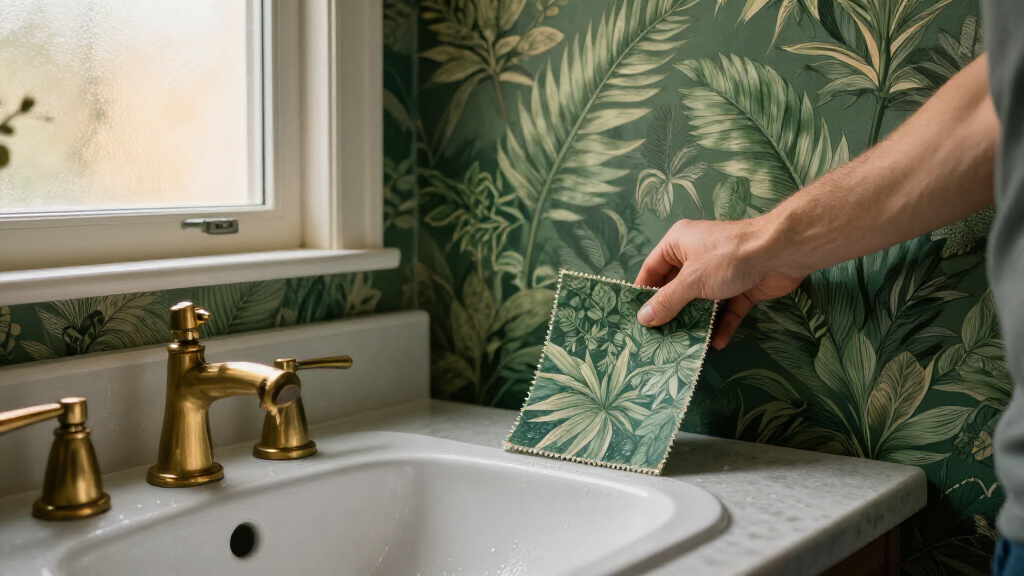
Several examples show wallpaper used to shape the atmosphere of smaller rooms. In a Philadelphia home, designer Brittany Hakimfar used a foliage-and-tree print in a petite powder room to bring warmth and visual impact to a large, bright home. In an Art Deco apartment with little natural light, interior designer Sheena Holton chose a playful design approach rather than trying to alter the developer’s bathroom layout. “It’s small but uplifting,” Holton said of the space.
Other projects use pattern in more restrained or layered ways. C&M Interiors applied wallpaper featuring historic-style nude figures sparingly, while designers Kristin Fine and Analisse Taft-Gerste of The 1818 Collective describe stripes as a way to give a room rhythm. Elsewhere, wallpaper appears on a wardrobe door concealing an ensuite, alongside patterned tile, or as a textured backdrop to a custom marble sink. The examples range from pale and delicate to dark, richly colored and maximalist.
How Pattern Changes Small Bathrooms
The projects show why designers may use wallpaper in a room with limited floor area: a wall covering can make a compact powder room feel deliberately designed without changing its footprint. A bold print can also establish a focal point, while a softer palette or a single papered wall can keep a pattern from dominating the room. These are design interpretations drawn from the featured projects, not guarantees that a particular treatment will make every small bathroom feel larger or more comfortable.
The report also points to wallpaper’s flexibility as a decorative element. It can complement existing tile and metal finishes, echo colors elsewhere in a home, or give an awkwardly shaped space a distinct identity. For readers planning a renovation, the examples offer visual options, but practical suitability depends on the product, the bathroom’s moisture and ventilation conditions, and how the finish is installed and maintained.
Products Worth Considering

Levoit Core 600S-P Smart Air Purifier for Large Rooms up to 2933 ft²

Philips Hue Smart Light Starter Kit with Bridge and 4 White and Color A19 Bulbs

Dyson Airstrait Styling Brush
As an affiliate, we earn on qualifying purchases.
From Utility Room to Design Feature
Livingetc frames its examples against a shift in how some homeowners approach bathrooms: from spaces treated mainly as functional to rooms that may receive the same attention to materials and decoration as other parts of a home. The report supports that framing with individual interiors, not market research or industry-wide data.
The featured approaches include foliage prints, fine-line illustrations, stripes, landscape imagery, floral patterns and crocodile-effect finishes. Some projects pair wallpaper with patterned floors or colored tile; others use it as the main decorative feature. The common thread is that designers choose a pattern and placement in response to the room’s size, light, finishes or intended mood.
“The wallpaper was used sparingly, but it truly ties everything together with historic-style nude muses with an antiqued backdrop.”
— Maria Hogrefe, C&M Interiors
Questions of Moisture and Longevity
The supplied report does not specify which wallpaper products were used, whether they were designed for damp environments, or how each installation is protected from moisture. It also gives no information on ventilation, maintenance, cost, installation methods or long-term performance. Those details matter because conditions vary across bathrooms, especially between a powder room and a room with a frequently used shower.
The examples are selected interiors and do not establish how common wallpaper is in bathroom renovations, whether it outperforms paint or tile, or what results homeowners can expect in their own homes. The source also does not provide a publication date, broader survey data or follow-up on how the featured spaces have held up over time.
Check Suitability Before Choosing Paper
The report offers design inspiration but does not announce a product launch, building standard or change to renovation guidance. Readers considering wallpaper can use the examples to narrow down choices of pattern and placement, then check the product maker’s instructions for the intended room and installation conditions. They may also want to discuss ventilation and preparation with a qualified installer, particularly for walls exposed to regular splashes or humidity.
No further development is specified in the source. The practical next step for any project is to confirm that the selected wall covering is appropriate for the room and that its care requirements fit how the bathroom is used.
Key Questions
What is the main point of Livingetc’s bathroom wallpaper report?
Livingetc argues that wallpaper can add character through pattern, color and texture, and presents projects where designers use it in bathrooms of different sizes and styles.
Does the report say wallpaper works in every bathroom?
No. The examples show design choices, but the supplied report does not establish that every wallpaper is appropriate for every bathroom. Moisture exposure, ventilation and product instructions should be checked for a specific room.
How do the featured designers use wallpaper in small bathrooms?
Examples include a foliage print in a petite powder room, a playful design in a low-light bathroom, and textured or bold finishes in compact spaces. Some projects use wallpaper across a room, while others apply it more sparingly.
Can wallpaper be combined with patterned tile?
The report includes a project pairing floral wallpaper with patterned tile and another combining palm-print wallpaper with red tiles. These examples show one approach, but they do not establish a universal design rule.
What should homeowners check before installing bathroom wallpaper?
Check the manufacturer’s guidance on room suitability, moisture exposure, installation and care. Bathroom conditions differ, so confirm that the product and installation plan suit the specific walls and ventilation.
Source: livingetc.com