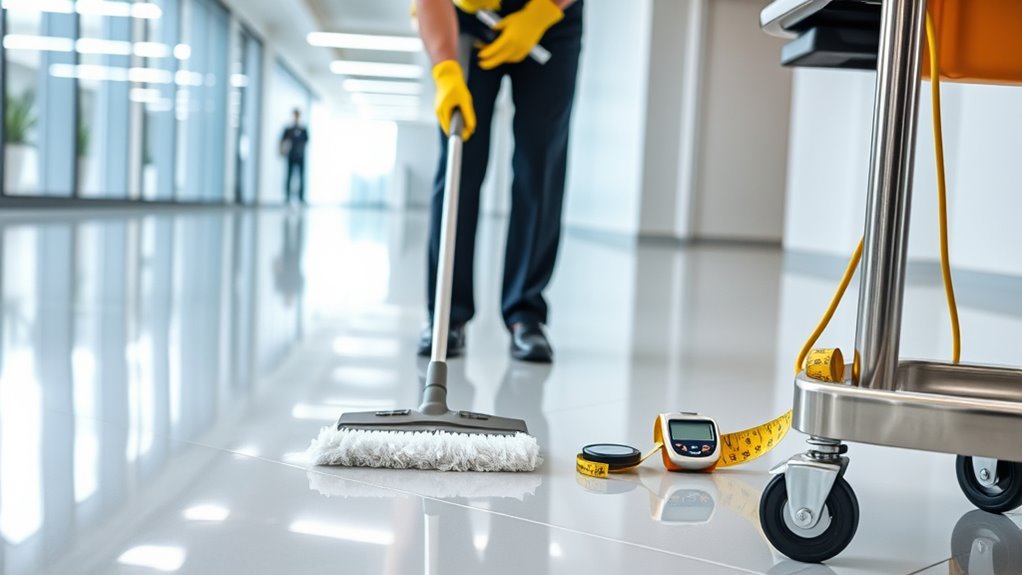

To calculate your cleaning productivity in square feet per hour, start by measuring the total area cleaned during a specific time frame. Then, divide that total by the number of hours worked. For example, if you clean 5,000 sq ft in 4 hours, your rate is 1,250 sq ft/hr. Tracking these numbers regularly can help you find ways to improve your efficiency—keep going to discover more effective strategies.
Key Takeaways
- Measure the total area cleaned over a specific time period to determine the output volume.
- Record the total hours worked, including break times, for accurate productivity calculation.
- Divide the total cleaned square footage by the total hours worked to get square feet per hour (sq ft/hr).
- Adjust the calculation to account for setup, interruptions, or breaks to ensure accuracy.
- Use the resulting sq ft/hr metric to compare performance against standards or previous results.

Calculating cleaning productivity is essential for measuring how efficiently cleaning tasks are completed. When you want to assess your team’s performance or improve your cleaning operations, understanding how to accurately determine productivity in square feet per hour (sq ft/hr) is vital. One of the most important factors influencing this calculation is your ability to manage time effectively. Good time management helps guarantee that cleaning time is used efficiently, avoiding unnecessary delays or overlaps that can skew your productivity measurements. By keeping track of exactly how long each task takes, you can identify whether delays are due to inefficiencies in process or equipment, and adjust accordingly. Additionally, understanding industry standards and benchmarks can provide valuable context for your performance metrics. Equipment efficiency plays a significant role in your cleaning productivity. High-quality, well-maintained equipment can drastically reduce the time needed to complete tasks. For example, using a powerful vacuum or an efficient floor scrubber can enable you to cover more area in less time. Conversely, outdated or poorly maintained equipment can slow down your operations, leading to lower sq ft/hr figures. When calculating productivity, you should factor in how effectively your equipment operates, as it directly affects your overall efficiency. Regularly inspecting and maintaining your tools ensures they perform at their best, helping you maximize your cleaning output. To begin calculating your cleaning productivity, start by measuring the total area cleaned within a specific period. For example, if you clean 5,000 square feet in four hours, your initial calculation is straightforward: divide the total square footage by the hours worked. In this case, 5,000 sq ft divided by 4 hours equals 1,250 sq ft/hr. This simple calculation gives you a baseline to compare against industry standards or your previous performance. Remember, though, it’s important to account for breaks, setup time, or any interruptions during the cleaning process, as these can impact the accuracy of your measurement. Monitoring cleaning productivity over time helps identify trends and areas for improvement. Next, evaluate how your time management and equipment efficiency contributed to this result. If your productivity rate is lower than desired, analyze whether delays were caused by inefficient scheduling, poor equipment, or other factors. Improving time management might involve better planning, assigning tasks more logically, or reducing downtime. Upgrading or maintaining equipment ensures you’re not losing time due to mechanical issues. Over time, by consistently tracking these metrics, you can identify patterns and implement targeted improvements, leading to higher sq ft/hr figures.
Frequently Asked Questions
How Do Seasonal Changes Affect Cleaning Productivity Rates?
Seasonal fluctuations and temperature impacts can substantially affect your cleaning productivity rates. In colder months, you might find it harder to work efficiently outdoors or in unheated spaces, slowing down your pace. Conversely, warmer seasons typically boost productivity as conditions are more comfortable. You’ll need to adjust your expectations and plan accordingly, considering how seasonal changes influence your ability to maintain consistent cleaning speeds throughout the year.
What Tools Can Improve Cleaning Efficiency?
Tools can boost your cleaning efficiency like a turbocharged engine. Investing in the latest cleaning technology, such as microfiber cloths, electric scrubbers, and advanced vacuum systems, speeds up tasks and improves quality. Pair these with thorough staff training to guarantee proper use and maintenance. When you combine innovative tools with skilled staff, you’ll see a significant increase in productivity, making your cleaning routines faster and more effective.
How Is Cleaning Productivity Affected by Different Surface Types?
Different surface types impact your cleaning productivity because surface durability dictates the appropriate cleaning techniques. For example, delicate surfaces require gentle methods, slowing your pace, while durable surfaces allow faster cleaning, boosting productivity. You should adjust your approach based on surface material, using specialized tools or techniques where needed. Recognizing these differences helps you optimize cleaning efficiency, ensuring thorough results without damaging surfaces or wasting time.
Can Cleaning Productivity Vary Between Commercial and Residential Spaces?
Yes, cleaning productivity can vary between commercial and residential spaces. Commercial spaces often require higher cleaning frequency and specialized staff training, which can impact your efficiency. In residential areas, you might find more flexibility, but inconsistent cleaning routines can slow you down. To optimize productivity, focus on proper staff training and maintaining a consistent cleaning schedule tailored to each space’s needs.
How Often Should Cleaning Productivity Be Reassessed for Accuracy?
Imagine your cleaning schedule as a road trip—regular check-ins keep you on course. You should reassess cleaning productivity every few months, especially after staff training sessions or when changing cleaning methods. This helps you identify if your team is managing time effectively and maintaining quality. By doing so, you make certain your staff’s efficiency improves, and your cleaning routines stay aligned with your goals, keeping everything running smoothly.
Conclusion
Now that you know how to calculate cleaning productivity in square feet per hour, you’re practically a superhero with a mop! Just remember, tracking your efficiency isn’t just about numbers – it’s your secret weapon for faster, better cleaning. Keep practicing, and soon you’ll be smashing through cleaning jobs like a whirlwind. With these skills, you’ll conquer any mess in record time, proving that your cleaning prowess is truly unstoppable!