
TL;DR

Get cleaning gear delivered free with Prime
- Fast, free delivery on millions of items
- Prime Video, Amazon Music and more included
- Member-only deals all year
A Hunker report describes a DIY countertop utensil holder made by joining the cut bottoms of two half-gallon milk jugs and covering them with craft sticks and jute twine. The project is a reuse idea, not a newly announced product; the report says one-gallon jugs may work better for longer utensils than for cutlery.
Hunker has reported on a DIY project that turns two used half-gallon milk jugs into a two-compartment countertop utensil holder, using cardboard, wooden craft sticks and jute twine. The idea offers a low-cost way to reuse household packaging, though the report does not provide a materials budget or testing of how durable the finished holder is.
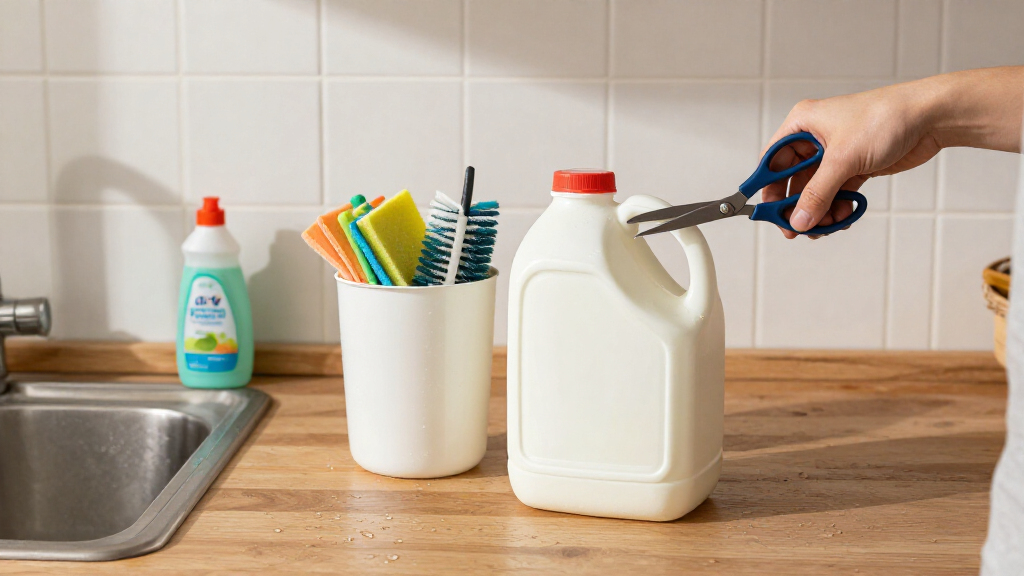
The project was demonstrated in a video by YouTuber Minno creation, according to Hunker. The maker cuts the bottoms from two half-gallon jugs, leaving a vertical tab, then glues the pieces together to form a container with two sections. A cardboard cutout is glued to the bottom to add stability.
The exterior is built up with popsicle sticks and jute twine, attached with a hot glue gun. The tutorial uses a substantial amount of glue, Hunker says. The jug handles are cut strategically to make the finished piece easier to carry, and one side receives a floral decoration. The report describes the result as a rustic-style cutlery holder.
The listed supplies include the jugs, cardboard, twine and craft sticks, along with scissors, a box cutter, a hot glue gun and glue sticks. Hunker’s article includes links to products and states that it may receive a commission from purchases made through them. The report does not specify how many sticks or how much twine the project uses.
A Reuse Project for Kitchen Counters
The project brings together two familiar household issues: used plastic containers and small items that collect on kitchen counters. Instead of buying a ready-made organizer, a person can adapt packaging and craft materials into a holder sized for utensils. That may appeal to people seeking a hands-on reuse project, although the source gives no price comparison with store-bought organizers.
Its practical value depends on the finished holder’s stability, dimensions and resistance to everyday kitchen conditions. The tutorial’s cardboard base is intended to steady the container, but Hunker does not report any testing of weight capacity, moisture resistance or long-term wear. The result is best understood as a craft idea rather than a verified storage product.
Products Worth Considering

BLUEAIR Mini Restful Air Purifier with Sunrise Alarm Clock and Nightlight

Dyson Car+Boat Cordless Handheld Vacuum

Dreame L50 Ultra Robot Vacuum and Mop Combo
As an affiliate, we earn on qualifying purchases.
How the Jug Holder Is Made
The reported method starts with two half-gallon jugs, whose cut lower sections become the two sides of the holder. The remaining plastic forms the structure, while a cardboard piece covers the base. Craft sticks and twine then conceal much of the plastic and create the finished look. A floral print is an optional decorative detail shown in the report.
Hunker says the design can theoretically be made with one-gallon jugs, but recommends the smaller containers for a cutlery holder. A gallon jug has a wider base that could leave forks, spoons and knives sitting too low to reach easily. The larger size may instead suit longer tools such as spatulas, ladles and whisks. For that version, the report suggests longer, jumbo craft sticks to cover the larger surface.
““The ½-gallon ones used by Minno creation are preferred.””
— Hunker
Durability and Exact Material Needs
The report does not give a complete materials count, a time estimate, or a cost for making the holder. It also does not say whether the finished piece was tested with heavy utensils, repeated handling or exposure to water and food spills. Those factors could affect whether it works well as an everyday kitchen organizer.
Hunker’s description does not provide detailed safety instructions for using a box cutter or hot glue gun. People following the project should use those tools carefully and follow their manufacturers’ safety directions; hot glue can cause burns, and blades can slip. The source also does not establish whether the floral design is painted, printed or applied another way.
Choosing a Size Before Cutting
Anyone considering the project should first decide what the holder needs to store. Half-gallon jugs are the version shown for cutlery; a one-gallon design may suit longer utensils, but would require more covering material and larger craft sticks. The source does not describe a tested pattern or exact measurements, so makers may need to adapt the layout to their jugs and tools.
After assembling the holder, its stability and suitability for the intended items remain matters for the maker to check. Hunker also points readers with only larger jugs toward other reuse projects, including decorative lighting and garden decor, but does not give further instructions for those alternatives in this report.
Key Questions
What does the DIY project make?
It makes a two-compartment countertop holder intended for cutlery, using the cut bottoms of two half-gallon milk jugs as its structure.
What supplies are used?
The report lists milk jugs, cardboard, jute twine, popsicle sticks, scissors, a box cutter, a hot glue gun and glue sticks. It does not give exact quantities for the materials.
Can a one-gallon milk jug be used?
Hunker says the project can theoretically be adapted, but the wider base may make a one-gallon version less suitable for cutlery. The report suggests it may work for longer tools such as spatulas, ladles and whisks.
Is the finished holder proven to be durable?
The source provides no durability, weight-capacity or moisture-resistance testing. Its account describes a craft tutorial, not a product evaluation.
Source: hunker.com