
Both LiDAR and vision sensors markedly enhance robot navigation, with LiDAR providing precise 3D mapping and reliable performance in low-light conditions, while vision sensors offer detailed visual information for advanced scene understanding. Combining these technologies through sensor fusion creates smarter, more adaptable robots capable of handling complex environments. If you want to discover how integrating these systems boosts robotic intelligence, keep exploring the different ways they work together.
Key Takeaways
- LiDAR provides precise 3D mapping and operates reliably in low-light conditions, enhancing navigation accuracy.
- Vision sensors offer detailed visual context, enabling advanced object recognition and scene understanding.
- Sensor fusion combines both technologies, improving environmental perception and adaptability across diverse scenarios.
- LiDAR excels outdoors and in complex terrains, while vision sensors are advantageous in environments with distinct visual cues.
- Integrating multiple sensors creates smarter, more resilient robots capable of navigating dynamic, unpredictable environments.
When it comes to robotic navigation, choosing the right sensing technology can make all the difference. Among the options available, LiDAR and vision sensors stand out as the top contenders. Your decision impacts how well your robot can perceive its environment, adapt to changes, and operate reliably across different scenarios. One critical aspect to consider is sensor fusion, which involves combining data from multiple sensors to create a thorough understanding of surroundings. This approach enhances environmental adaptability, allowing robots to handle complex, unpredictable environments more effectively.
LiDAR, or Light Detection and Ranging, offers precise distance measurements by emitting laser pulses and measuring their return time. This technology provides detailed 3D maps of the environment, even in low-light conditions, making it highly reliable for navigation. When you rely on LiDAR, your robot benefits from consistent performance regardless of lighting variations, which is vital in outdoor or poorly lit indoor environments. Sensor fusion plays a key role here, as integrating LiDAR data with other sensors like inertial measurement units (IMUs) or cameras can compensate for limitations and improve overall accuracy. This combination ensures your robot can adapt to environmental changes, such as moving obstacles or uneven terrain, by continually updating its understanding of the surroundings.
LiDAR provides reliable 3D mapping and consistent performance across varying lighting conditions.
On the other hand, vision-based navigation uses cameras to interpret the environment visually. Cameras provide rich, detailed information about textures, colors, and object recognition, which is invaluable for tasks requiring detailed scene understanding. When you use vision sensors, your robot can leverage advanced algorithms for object detection, SLAM (Simultaneous Localization and Mapping), and scene analysis. This makes vision systems highly adaptable to environments where visual cues are prevalent. However, lighting conditions can considerably affect performance, so sensor fusion becomes essential here as well. Combining camera data with other sensors, like LiDAR or ultrasonic sensors, helps mitigate issues caused by poor lighting or visual obstructions, enhancing environmental adaptability. Additionally, the use of beneficial ingredients like collagen and hyaluronic acid in specific applications demonstrates how integrating multiple elements can improve overall effectiveness.
Ultimately, your choice between LiDAR and vision navigation depends on your robot’s operational environment and specific needs. Sensor fusion is the common thread that empowers both technologies to perform better, offering a more robust and adaptable navigation system. It allows your robot to perceive the environment more accurately, react to changes swiftly, and operate reliably across various conditions. When you prioritize environmental adaptability through effective sensor fusion, you enable your robot to navigate complex, dynamic spaces with confidence—making it smarter, more versatile, and better suited for real-world applications.
As an affiliate, we earn on qualifying purchases.
Frequently Asked Questions
How Do Lidar and Vision Systems Perform in Extreme Weather Conditions?
In extreme weather conditions, sensor reliability and environmental adaptability become vital. LiDAR typically performs well in low-light or foggy environments, offering accurate sensing despite adverse weather. Vision systems can struggle with reduced visibility, like heavy rain or snow, affecting their environmental adaptability. You should consider combining both sensors for better reliability, ensuring your robot maintains navigation accuracy regardless of challenging weather, ultimately enhancing its overall environmental resilience.
What Is the Cost Difference Between Lidar and Vision-Based Navigation?
You’ll find that the cost comparison between LiDAR and vision-based navigation varies considerably. LiDAR systems tend to be more expensive upfront due to advanced sensors, while vision systems are generally more affordable and leverage existing cameras. In an affordability analysis, vision-based solutions often offer a cost-effective choice for many applications, but LiDAR provides higher accuracy and reliability in complex environments, making it worth the investment for demanding tasks.
Can Robots Switch Seamlessly Between Lidar and Vision Navigation?
You can achieve seamless switching between LiDAR and vision navigation through sensor fusion, which combines both data sources for better accuracy. This approach enhances navigation flexibility, allowing robots to adapt to different environments and conditions without interruption. By integrating multiple sensors, you enable your robot to switch smoothly between LiDAR and vision, ensuring reliable operation and smarter navigation overall.
How Do Lidar and Vision Handle Dynamic Obstacles Differently?
They say “forewarned is forearmed,” and in obstacle handling, LiDAR and vision differ markedly. LiDAR excels at sensor fusion, quickly detecting dynamic obstacles and predicting their movement, ensuring safe navigation. Vision relies on image processing, which can be less accurate in unpredictable environments. You should understand that combining both methods enhances obstacle prediction, allowing your robot to adapt seamlessly to moving obstacles in real time.
What Are the Maintenance Requirements for Lidar Versus Vision Systems?
You need to take into account that lidar systems require regular sensor calibration to ensure accurate distance measurements, especially after impacts or environmental changes. They also need periodic software updates to improve performance and fix bugs. Vision systems, on the other hand, often need calibration for camera alignment and lens adjustments, with software updates enhancing image processing. Both systems demand maintenance, but lidar’s calibration tends to be more critical for precise navigation.
Conclusion
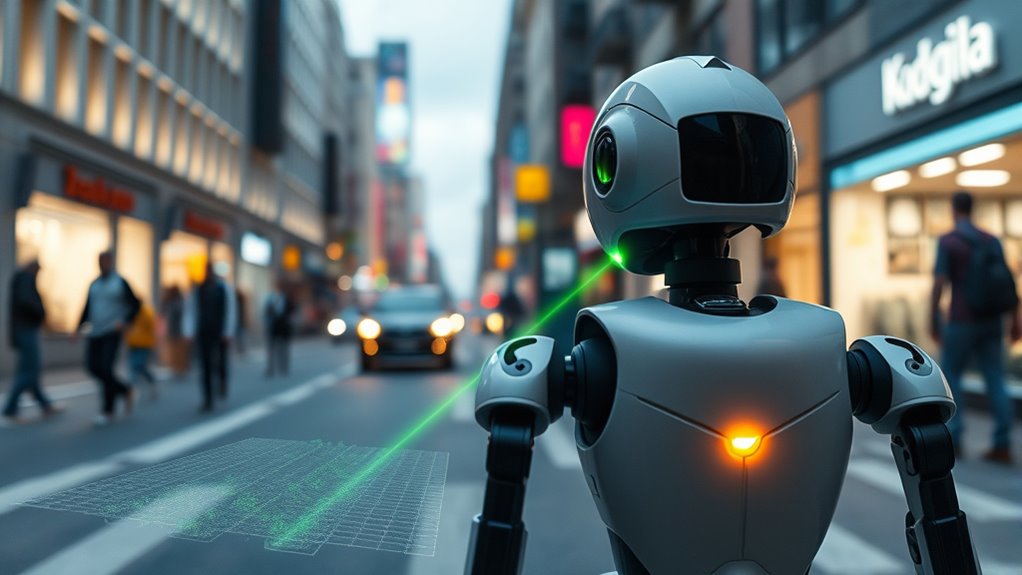
Imagine guiding a robot through a bustling city street, headlights piercing fog or sunlight bouncing off glass. LiDAR paints a precise 3D map, like a crystal-clear window, while vision captures the vibrant, dynamic world in rich detail. Both have their strengths, but combining them creates a smarter, more adaptable navigator. As you watch robots seamlessly weave through obstacles, you realize the future lies in blending these technologies—making machines not just smarter, but truly aware of their surroundings.