
To reduce false obstacles in your robotic cleaner, start by regularly cleaning and calibrating its sensors, like infrared or ultrasonic ones, to guarantee accurate detection. Fine-tune navigation settings to ignore minor signals and adjust sensitivity levels to prevent false alarms. Keep your space clutter-free by removing small objects and cords that can confuse the robot. Upgrading to a machine with advanced sensors or multi-sensor systems can also improve obstacle discrimination. For more tips, discover how environmental adjustments and firmware updates can boost your robot’s performance.

Get cleaning gear delivered free with Prime
- Fast, free delivery on millions of items
- Prime Video, Amazon Music and more included
- Member-only deals all year
Key Takeaways
- Regularly clean and calibrate obstacle sensors to ensure accurate readings.
- Adjust navigation sensitivity settings to filter out minor or irrelevant signals.
- Keep floors clutter-free by removing small objects and loose cables.
- Use advanced robots with multi-sensor systems for better obstacle discrimination.
- Update firmware and navigation algorithms to enhance obstacle detection accuracy.
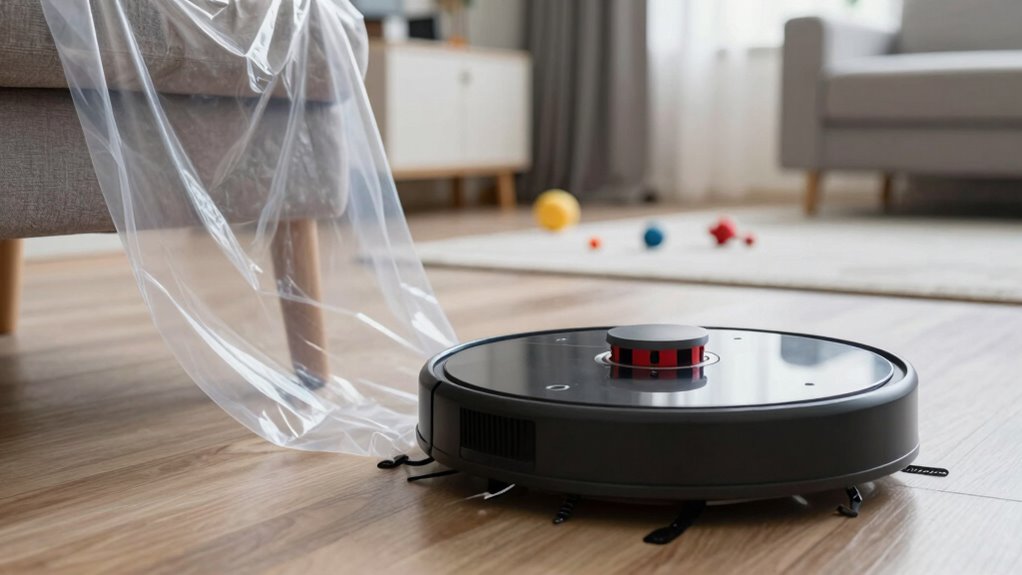
Robotic cleaning devices have become a common part of many households, but they often encounter obstacles that hinder their efficiency. One major challenge is false obstacles—objects that the robot mistakenly identifies as real barriers, causing unnecessary stops or rerouting. To reduce these false positives, understanding how navigation algorithms work is essential. These algorithms determine the robot’s path by processing data from obstacle sensors and deciding whether an object is a true obstacle or just a harmless item like a cable or a shadow. Improving these algorithms can substantially enhance the robot’s ability to distinguish real threats from false ones, making cleaning more seamless. Regularly updating firmware can also incorporate navigation algorithm improvements that help reduce false obstacle detections.
Understanding navigation algorithms helps robotic cleaners better distinguish real obstacles from false alarms.
Obstacle sensors are the primary tools the robot uses to detect its surroundings. These sensors include infrared, ultrasonic, or laser-based systems that send signals and interpret reflections to identify objects nearby. However, these sensors can sometimes pick up false signals, especially when encountering shiny surfaces, transparent objects, or reflections. To minimize false obstacles, you should regularly clean the sensors to remove dust or debris that can interfere with their accuracy. Ensuring that sensors are free from obstructions helps maintain precise readings, reducing the chances of misidentifying objects. Proper calibration of sensors can further enhance their ability to accurately interpret environmental data.
Another effective way to cut down on false obstacles is to fine-tune the navigation algorithms. Many modern robots allow you to customize sensitivity levels or update their software to improve obstacle discrimination. By adjusting parameters within the algorithms, you enable the device to better interpret sensor data, ignoring minor or irrelevant signals that previously triggered false obstacles. Manufacturers often release firmware updates that refine these algorithms, so keeping your device’s software current can lead to better obstacle detection. Additionally, some models use multi-sensor integration to improve obstacle differentiation, which can significantly reduce false positives.
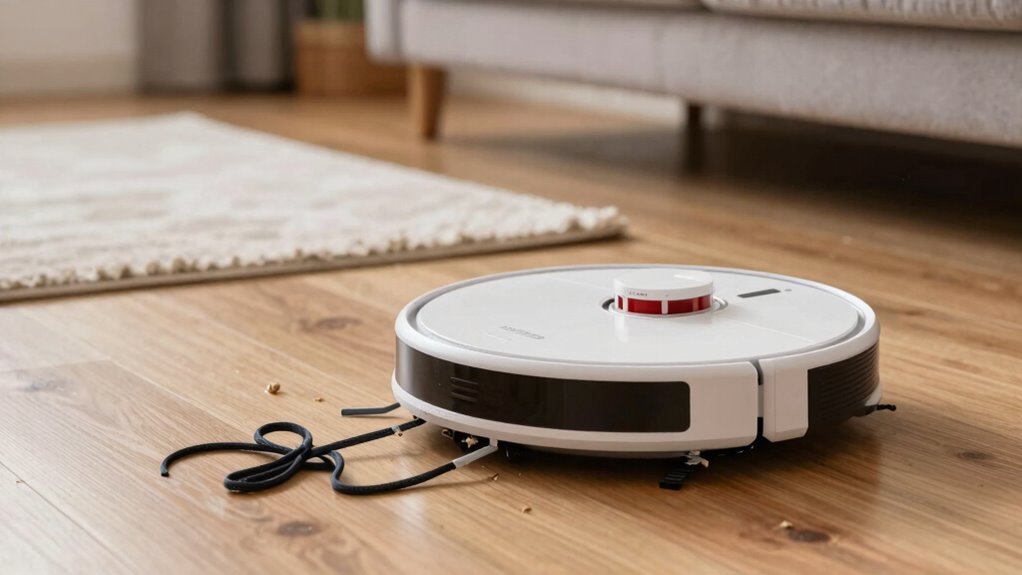
In addition, creating a clutter-free environment helps your robotic cleaner operate more efficiently. Keep cables, small objects, and lightweight items off the floor, especially in areas where the robot spends most of its time. This minimizes the chances of sensors misinterpreting these objects as obstacles. If your robot struggles with certain surfaces or objects, consider repositioning or removing them to improve navigation. Consistently maintaining a tidy space can greatly enhance the robot’s ability to navigate accurately.
Lastly, consider investing in a robot with advanced navigation algorithms and high-quality obstacle sensors. These models are designed to better differentiate between real obstacles and false signals, thanks to sophisticated processing techniques and multi-sensor integration. Such upgrades can notably reduce false obstacle detections, making your robotic cleaner more efficient and reliable. By understanding how navigation algorithms and obstacle sensors work together, you can take steps to optimize your device’s performance, ensuring a smoother, more effective cleaning experience without unnecessary interruptions caused by false obstacles.
robot vacuum sensor cleaning kit
As an affiliate, we earn on qualifying purchases.
As an affiliate, we earn on qualifying purchases.
Frequently Asked Questions
How Can I Prevent My Robot From Mistaking Shadows for Obstacles?
To prevent your robot from mistaking shadows for obstacles, you should adjust its sensors and cleaning settings. Reduce shadow interference by repositioning furniture or curtains that cast misleading shadows. You can also enable obstacle false positives filtering, which helps the robot distinguish real objects from shadows. Regularly update your robot’s firmware and calibrate sensors to improve accuracy. These steps guarantee your robot navigates efficiently without unnecessary stops caused by shadow misinterpretation.
What Sensors Are Most Effective in Obstacle Detection?
Infrared and ultrasonic sensors are most effective for obstacle detection. Infrared sensors detect nearby objects by measuring reflected light, making them good for close-range detection. Ultrasonic sensors use sound waves to measure distance, providing reliable detection over a range of sizes and materials. Combining both sensors allows your robot to accurately identify obstacles, reducing false alerts caused by shadows or reflections, and ensuring thorough cleaning without unnecessary stops.
How Often Should I Update My Robot’s Software?
Imagine your robot gliding smoothly across your floors, its sensors finely tuned. You should update its robot firmware every few months or whenever the manufacturer releases new versions. Regular updates guarantee ideal obstacle calibration, reducing false obstacles and improving navigation. Keep an eye out for software alerts, and don’t delay updating, so your robot stays efficient and responsive, seamlessly cleaning without interruptions or false detections.
Can Changing Floor Types Reduce False Obstacle Detection?
Changing floor types can reduce false obstacle detection by improving sensor calibration and floor optimization. When you switch to a surface that better reflects the robot’s sensors, it can more accurately distinguish between real obstacles and false ones. Regularly calibrate your sensors and optimize your floors for your robot’s specific needs. This helps the device navigate efficiently, minimizing false detections and ensuring a thorough clean without unnecessary interruptions.
Are There Specific Cleaning Schedules to Minimize False Obstacles?
You can minimize false obstacles by establishing specific cleaning routines that include regular obstacle calibration. Schedule your robot to perform calibration checks during low-traffic times, ensuring sensors stay accurate. Consistent cleaning routines help detect changes in your environment, allowing the robot to adapt and recognize real obstacles. By maintaining a routine and calibrating sensors regularly, you’ll reduce false obstacle detection and improve your robot’s overall efficiency.
Conclusion
Just as Da Vinci sought harmony in art and science, you can balance your robotic cleaner’s environment for flawless performance. By reducing false obstacles, you’re creating a smooth path akin to a well-orchestrated symphony, where every note—or obstacle—is perfectly in tune. Embrace these simple adjustments, and watch your robot glide effortlessly, turning your cleaning routine into a masterpiece of efficiency. Remember, a clutter-free space invites the same grace that fueled the great inventor’s genius.
Halloween Picks
halloween
As an affiliate, we earn on qualifying purchases.