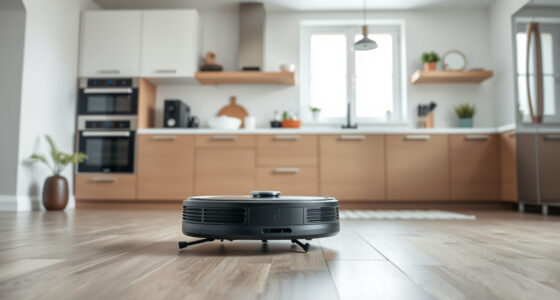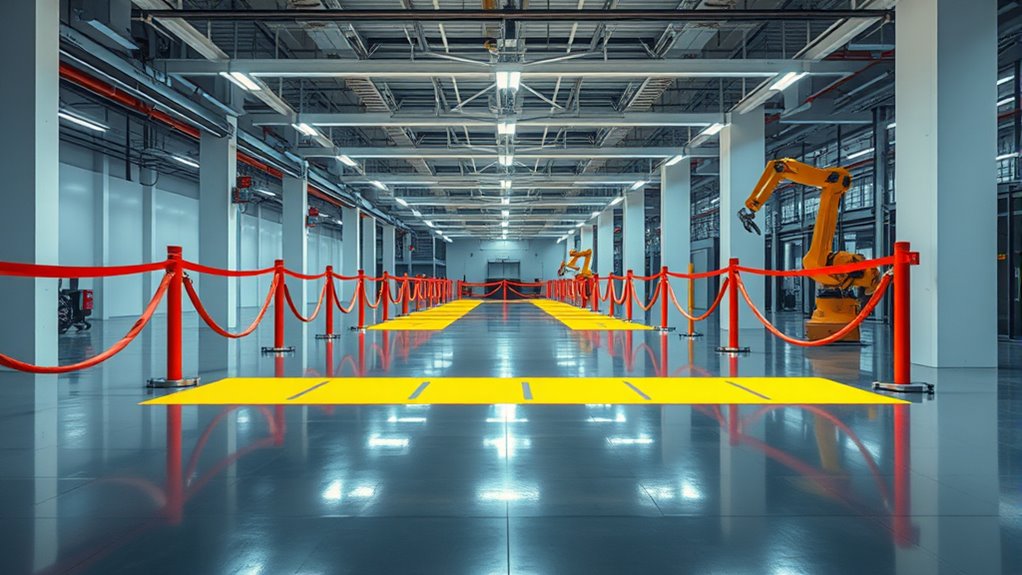

To select areas and no-go zones for your robot, start by mapping your environment with clear boundaries for important tasks like cleaning or surveillance. Use sensors and algorithms to detect obstacles and hazards, then define no-go zones around stairs, delicate furniture, or cluttered spots. Keep the map updated as your space changes, and adjust zones as needed for safety and efficiency. To learn more about effective zone management, continue exploring the key strategies.

Get cleaning gear delivered free with Prime
- Fast, free delivery on millions of items
- Prime Video, Amazon Music and more included
- Member-only deals all year
Key Takeaways
- Use mapping algorithms to accurately identify safe and restricted areas within the environment.
- Designate no-go zones for hazards, high-traffic, or sensitive spaces, updating them regularly.
- Utilize obstacle detection sensors to inform zone boundaries and avoid accidental entry.
- Employ intuitive interfaces for dynamic zone resizing and environment updates.
- Prioritize safety and efficiency by clearly marking zones based on environment analysis and sensor data.

Choosing the right areas and no-go zones for your robots is vital to make certain of safe and efficient operation. When you’re setting up your robotic system, it’s fundamental to understand how mapping algorithms play a central role in defining these zones. Mapping algorithms help your robot create a detailed layout of the environment, identifying navigable spaces and potential hazards. These algorithms analyze sensor data to generate accurate maps, guaranteeing your robot knows where it can move freely and where it should avoid. By leveraging sophisticated mapping techniques, you can designate specific areas as safe pathways and restrict access to sensitive or hazardous zones, maximizing performance and safety.
Effective mapping algorithms define safe zones, identify hazards, and optimize your robot’s environment for safe, efficient operation.
Obstacle detection is another key factor in this process. Your robot relies on obstacle detection sensors—such as lidar, ultrasonic, or infrared—to identify objects in its environment. Properly configuring obstacle detection ensures the robot recognizes barriers like furniture, walls, or even moving people, and responds accordingly. When setting no-go zones, you need to think about the robot’s obstacle detection capabilities so it can avoid these areas without constant human intervention. This proactive approach prevents accidents and damage, maintaining a smooth operation.
In choosing areas for your robot, think about the tasks you want it to perform. For example, if it’s a cleaning robot, you may want to map out high-traffic zones for frequent attention and restrict access to delicate or restricted areas like bedrooms or sensitive equipment. Use the data from your mapping algorithms to mark these zones clearly, ensuring the robot understands its boundaries. Conversely, no-go zones should be established in locations where obstacles are unpredictable or where safety concerns exist, such as staircases, cluttered corners, or construction sites. By setting these zones precisely, you prevent the robot from entering unsafe or inefficient areas.
It’s also wise to regularly update your maps as your environment changes. Furniture moves, new obstacles appear, or no-go zones need resizing—these updates keep your robot functioning at its best. Many modern robots support dynamic mapping, allowing you to adjust zones on the fly using intuitive interfaces. Combining effective mapping algorithms with reliable obstacle detection means your robot can navigate complex environments seamlessly, respecting the boundaries you’ve set. This synergy ensures your robot operates safely, avoids hazards, and maintains productivity without constant oversight.
Ultimately, choosing the right areas and no-go zones involves understanding your environment, leveraging advanced mapping algorithms, and guaranteeing obstacle detection works effectively. When you do this right, your robot will not only operate more efficiently but also stay safe and reliable, giving you peace of mind and freeing you from micromanagement.
robot obstacle detection sensors
As an affiliate, we earn on qualifying purchases.
As an affiliate, we earn on qualifying purchases.
Frequently Asked Questions
How Do Robots Identify No-Go Zones Autonomously?
You guarantee your robot identifies no-go zones autonomously by utilizing sensor calibration and obstacle detection. The robot’s sensors, once calibrated, detect obstacles and analyze their surroundings in real-time. It then maps out areas with barriers or hazards, assigning them as no-go zones. This process allows the robot to navigate safely, avoiding restricted areas without human intervention, by constantly updating its environment through accurate sensor data and obstacle detection algorithms.
What Are the Safety Protocols for No-Go Zones?
You want safety in no-go zones, and it starts with thorough sensor calibration, ensuring obstacle detection is flawless. When sensors are correctly calibrated, the robot can accurately recognize hazards, preventing accidents. Safety protocols include real-time monitoring, automatic shutdowns if obstacles are detected unexpectedly, and regular system checks. These measures work together to keep everyone safe, turning the robot’s awareness into a reliable safeguard, especially when moments of coincidence remind you how crucial precision is.
Can No-Go Zones Be Dynamically Adjusted in Real-Time?
Yes, no-go zones can be dynamically adjusted in real time using dynamic mapping and real-time updates. You can program your robot to continuously monitor its environment, allowing it to modify restricted areas instantly as conditions change. This flexibility helps guarantee safety and efficiency, especially in unpredictable environments. By leveraging real-time data, you keep the robot’s no-go zones current, preventing accidents and optimizing performance without manual reprogramming.
How Do Different Terrains Affect Zone Selection?
Different terrains considerably impact zone selection because terrain variability affects a robot’s ability to navigate safely. Rough or uneven surfaces challenge obstacle detection, requiring you to set no-go zones more conservatively. Smooth, flat terrains allow for larger operational areas, but you must still account for obstacle detection limitations. Adjust your zones based on terrain conditions to optimize safety and efficiency, ensuring your robot navigates effectively across diverse environments.
What Are the Legal Considerations for Restricting Robot Areas?
You need to guarantee legal compliance and follow zoning regulations when restricting robot areas. Check local laws to avoid fines or penalties, especially in sensitive zones like residential or industrial areas. Obtain necessary permits if required, and stay updated on regulations that might affect your restrictions. Clear signage and documentation help demonstrate compliance, reducing legal risks and ensuring your robot operations remain within legal boundaries.
Conclusion
By carefully selecting areas and no-go zones, you’re crafting an invisible map that guides your robot’s journey through a world full of hidden pitfalls and safe harbors. Think of it as planting seeds in fertile ground while shielding delicate blooms from storms. With this thoughtful approach, you’re not just programming a machine—you’re orchestrating a dance of precision and trust, turning chaos into harmony and ensuring your robot navigates with purpose and grace.
Fall Picks
fall essentials
As an affiliate, we earn on qualifying purchases.