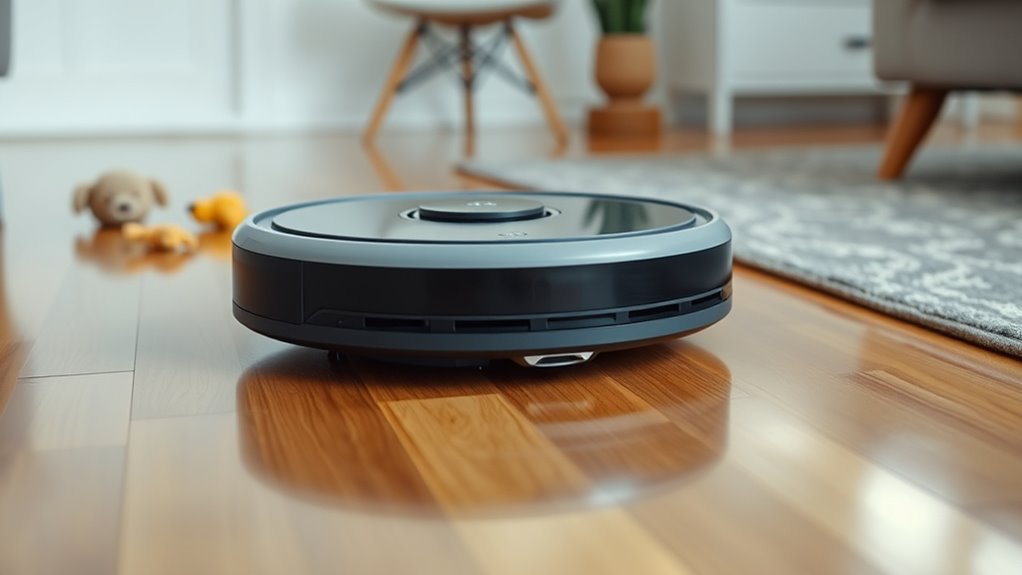
Robot cleaner obstacle avoidance sensors can help a vacuum spot everyday clutter, but performance depends on more than a sensor label: navigation, software, and the room itself all matter. Among these six models, I rank the Roborock Qrevo 2 Pro best overall for shoppers seeking a capable all-round vacuum-and-mop setup, while the Dreame D30 Ultra CE stands out for buyers who prioritize dock automation and the ILIFE A30s for those focused on LiDAR mapping. The central tradeoff is between smarter obstacle response and the cost, upkeep, or feature complexity that may come with a more automated system. I also weigh how each model’s navigation and dock features fit different household needs rather than treating sensors as a standalone guarantee. Read on for the full comparison and advice on which approach suits your floors, clutter, and routine.

Get cleaning gear delivered free with Prime
- Fast, free delivery on millions of items
- Prime Video, Amazon Music and more included
- Member-only deals all year
Complete the kit


Key Takeaways
- Roborock Qrevo 2 Pro takes the overall lead because it presents the strongest all-round case among the listed vacuum-and-mop options, not because any sensor can promise that it will avoid every object.
- Dreame D30 Ultra CE and iRobot Roomba Plus 505X make the most sense for buyers who value dock automation, but dock convenience and obstacle avoidance are separate benefits.
- ILIFE A30s is the clearest LiDAR-focused pick; mapping helps with route planning, but LiDAR navigation alone should not be confused with reliable recognition of small floor clutter.
- SwitchBot S20’s Matter support is a smart-home differentiator, while its suitability depends on whether connected-home control matters more to you than a sensor-first buying decision.
- BOTLUXE T30+ is harder to rank ahead of the more clearly differentiated alternatives without confirmed sensor details, so buyers should verify its obstacle-detection capabilities before choosing it for cluttered rooms.
| BOTLUXE T30+ Robot Vacuum and Mop with Self-Emptying Station |  | Best Value for Long Runs | Suction: 12,000 Pa | Navigation and avoidance: LiDAR and linear laser obstacle avoidance | Runtime: Up to 240 minutes in description; 150 minutes in specifications | VIEW ON AMAZON | See Our Full Breakdown |
| Dreame D30 Ultra CE Robot Vacuum and Mop |  | Best for High-Suction Cleaning | Suction: 25,000 Pa | Battery life: 180 minutes | Dust bag: 3.2 L; up to 100 days of dust disposal | VIEW ON AMAZON | See Our Full Breakdown |
| Roborock Qrevo 2 Pro Robot Vacuum and Mop |  | Best for Long-Runtime Edge Cleaning | Suction: 20,000 Pa | Battery life: 253 minutes | Navigation: LiDAR mapping and obstacle avoidance | VIEW ON AMAZON | See Our Full Breakdown |
| iRobot Roomba Plus 505X Robot Vacuum and Mop Combo with AutoWash Dock |  | Best for Recognizing Household Clutter | Navigation: ClearView Pro LiDAR | Obstacle avoidance: PrecisionVision AI recognizes cords, socks, and pet waste | Cleaning modes: Vacuum, mop, combo clean, or vacuum-then-mop | VIEW ON AMAZON | See Our Full Breakdown |
| SwitchBot S20 Robot Vacuum and Mop with Matter |  | Best for Matter Smart-Home Integration | Suction: 10,000 Pa | Obstacle avoidance: AI visual avoidance of over 100 types of household clutter | Dust bag: 4 L | VIEW ON AMAZON | See Our Full Breakdown |
| ILIFE A30s Robot Vacuum with LiDAR Navigation |  | Best for Vacuum-Only, Mapped Cleaning | Navigation: LDS LiDAR with SLAM | Maximum suction: 10,000 Pa | Dustbin capacity: 500 ml | VIEW ON AMAZON | See Our Full Breakdown |
| robot cleaner obstacle avoidance sensor | Suction | Connectivity | Dust bag | Battery life |
|---|---|---|---|---|
| BOTLUXE T30+ Robot Vacuum and | 12,000 Pa | App and voice control; 2.4 GHz Wi-Fi | 3.5 L; rated for up to 75 days | — |
| Dreame D30 Ultra CE Robot Vacu | 25,000 Pa | App and voice control; 2.4 GHz Wi-Fi | 3.2 L; up to 100 days of dust disposal | 180 minutes |
| Roborock Qrevo 2 Pro Robot Vac | 20,000 Pa | App, button, and voice control; 2.4 GHz Wi-Fi | — | 253 minutes |
| iRobot Roomba Plus 505X Robot | Up to 70× stronger than Roomba 600 series robots | — | — | — |
| SwitchBot S20 Robot Vacuum and | 10,000 Pa | Matter and 2.4 GHz Wi-Fi | 4 L | — |
| ILIFE A30s Robot Vacuum with L | — | — | — | 150 minutes |
More Details on Our Top Picks
BOTLUXE T30+ Robot Vacuum and Mop with Self-Emptying Station
The BOTLUXE T30+ pairs LiDAR mapping with linear laser obstacle avoidance, making it a practical choice for homes that need mapped cleaning and obstacle detection without a complex mop-washing dock. Its 3.5 L bag is rated for up to 75 days of dust disposal, and the rubber brush is designed to limit hair buildup between cleanups. Compared with the iRobot Roomba Plus 505X, its obstacle-sensing details are less specific: the Roomba explicitly identifies cords, socks, and pet waste, while BOTLUXE lists obstacle avoidance without naming recognized objects. The T30+ does add a stated runtime of up to 240 minutes, though another specification lists 150 minutes, so I would not treat the longer figure as guaranteed. It suits buyers who value self-emptying and broad floor coverage over detailed object recognition.
Pros:- LiDAR mapping and linear laser obstacle avoidance support guided cleaning around the home.
- 3.5 L self-emptying bag is rated for up to 75 days of dust disposal.
- Tangle-resistant rubber brush is designed to reduce hair buildup.
- Combines vacuuming and mopping with carpet detection and app and voice control.
Cons:- Obstacle avoidance is not described with specific recognized object types, unlike the Roomba Plus 505X.
- Runtime figures conflict: the description says up to 240 minutes, while specifications list 150 minutes.
- Works with 2.4 GHz Wi-Fi only and is specified for 110–120 V.
Best for: Households wanting mapped vacuum-and-mop cleaning, a large dust bag, and long listed runtime without a mop-washing station.
Not ideal for: Buyers who need clearly specified recognition of cords or pet waste, or whose home network uses only 5 GHz Wi-Fi.
- Suction:12,000 Pa
- Navigation and avoidance:LiDAR and linear laser obstacle avoidance
- Runtime:Up to 240 minutes in description; 150 minutes in specifications
- Dust bag:3.5 L; rated for up to 75 days
- Brush:Tangle-resistant rubber brush
- Filter:HEPA
- Connectivity:App and voice control; 2.4 GHz Wi-Fi
- Voltage:110–120 V
Our verdict“Choose the BOTLUXE T30+ for mapped cleaning and a large self-emptying bag, but pick the Roomba Plus 505X if named-object recognition matters more.”
Dreame D30 Ultra CE Robot Vacuum and Mop
The Dreame D30 Ultra CE stands out for pairing 25,000 Pa suction with a dock that washes and hot-air dries its mop pads. That combination suits homes where strong pickup and reduced mop maintenance matter as much as obstacle avoidance. Its laser mapping and carpet detection help guide cleaning, and the mop can lift up to 0.41 inches over carpet. The product details do not specify which objects its avoidance system recognizes, so buyers focused on cords or pet waste may prefer the iRobot Roomba Plus 505X, which names those examples. Compared with the Roborock Qrevo 2 Pro, Dreame lists higher suction, while Roborock gives a longer stated battery life and specific edge-cleaning distance. The D30’s 180-minute battery life and 2.4 GHz-only Wi-Fi are practical limits for some homes.
Pros:- Listed 25,000 Pa suction with five selectable suction levels.
- Dock washes and hot-air dries mop pads, reducing hands-on mop care.
- Self-empties into a 3.2 L dust bag rated for up to 100 days.
- Carpet detection can lift the mops up to 0.41 inches.
Cons:- Obstacle avoidance is not specified by recognized object type.
- Supports 2.4 GHz Wi-Fi only.
- Listed for use in the USA only, and battery life is 180 minutes.
Best for: Owners of mixed carpet and hard-floor homes who want strong listed suction, mop-pad washing and drying, and mapped cleaning.
Not ideal for: Buyers who need 5 GHz Wi-Fi, detailed published object-recognition claims, or a robot specified for use outside the USA.
- Suction:25,000 Pa
- Battery life:180 minutes
- Dust bag:3.2 L; up to 100 days of dust disposal
- Dust box:300 ml
- Mop lift:Up to 0.41 in
- Threshold clearance:0.79 in
- Dock functions:Dust emptying, mop-pad washing, and hot-air drying
- Connectivity:App and voice control; 2.4 GHz Wi-Fi
Our verdict“Choose the Dreame D30 Ultra CE for high listed suction and automated mop care, but favor the Roomba Plus 505X for more explicit household-object recognition.”
Roborock Qrevo 2 Pro Robot Vacuum and Mop
The Roborock Qrevo 2 Pro is a strong fit for larger homes where long battery life and close wall cleaning matter alongside obstacle avoidance. Its LiDAR mapping supports scheduled, app-controlled routes, while its edge system is specified to clean as close as 1.85 mm along walls. The dock empties dust, refills water, and washes and dries the mops, though that many automated functions also mean more dock upkeep. Compared with the Dreame D30 Ultra CE, Roborock lists lower suction but a longer 253-minute battery life and a quantified edge-cleaning distance. The iRobot Roomba Plus 505X provides more explicit AI recognition examples, including cords and socks; Roborock’s supplied details do not name the objects it can avoid. Its 2.4 GHz-only Wi-Fi may also rule it out for some networks.
Pros:- 253-minute stated battery life supports longer cleaning sessions than the Dreame D30 Ultra CE’s listed 180 minutes.
- LiDAR mapping and obstacle avoidance support scheduled, guided cleaning.
- Edge system is specified to clean as close as 1.85 mm along walls.
- Dock empties dust, refills water, and washes and dries the mops.
Cons:- Obstacle avoidance details do not identify which household objects the robot recognizes.
- Multifunction dock and mop system may require regular upkeep.
- Supports 2.4 GHz Wi-Fi only.
Best for: Owners of larger mixed-floor homes who want long stated runtime, close wall cleaning, and a dock that handles dust and mop care.
Not ideal for: Buyers who prioritize published recognition of specific clutter types, want minimal dock maintenance, or use only 5 GHz Wi-Fi.
- Suction:20,000 Pa
- Battery life:253 minutes
- Navigation:LiDAR mapping and obstacle avoidance
- Edge cleaning:As close as 1.85 mm along walls
- Mop lift:Up to 15 mm
- Dock functions:Dust emptying, water refilling, mop washing, and drying
- Mop washing temperature:149°F
- Connectivity:App, button, and voice control; 2.4 GHz Wi-Fi
Our verdict“Choose the Qrevo 2 Pro for long listed runtime and detailed edge-cleaning capability, but choose the Roomba Plus 505X if named-object avoidance is your priority.”
iRobot Roomba Plus 505X Robot Vacuum and Mop Combo with AutoWash Dock
The Roomba Plus 505X is the clearest choice here for buyers who put specific obstacle recognition ahead of a headline suction figure. Its PrecisionVision AI is described as recognizing cords, socks, and pet waste, while ClearView Pro LiDAR maps rooms for planned routes. That gives buyers more concrete information about what its avoidance system is meant to handle than the BOTLUXE T30+ or Roborock Qrevo 2 Pro provide in their listed details. The AutoWash Dock empties debris for up to 75 days and washes and heat-dries the dual spinning mop pads, which lift over carpet. Unlike Dreame’s D30 Ultra CE, however, Roomba’s suction is expressed as a comparison with Roomba 600 series robots rather than a Pa figure, making direct suction comparisons difficult. The dock also needs dedicated space and periodic care.
Pros:- PrecisionVision AI is specified to recognize cords, socks, and pet waste.
- ClearView Pro LiDAR supports room mapping and planned navigation.
- AutoWash Dock empties debris for up to 75 days and washes and heat-dries mop pads.
- Dual spinning pads lift over carpet, and multiple cleaning modes support different routines.
Cons:- Suction is described relative to Roomba 600 series robots, not with a Pa figure for direct comparison with Dreame or Roborock.
- Robot and dock require substantial storage space.
- Dock requires occasional maintenance, including debris-bag replacement.
Best for: Households with pets, children, or frequently scattered cords and socks that want clearly described object recognition and automated mop care.
Not ideal for: Buyers comparing robots by Pa suction figures, homes without room for a substantial dock, or anyone wanting a compact cleaning setup.
- Navigation:ClearView Pro LiDAR
- Obstacle avoidance:PrecisionVision AI recognizes cords, socks, and pet waste
- Cleaning modes:Vacuum, mop, combo clean, or vacuum-then-mop
- Mop pads:Dual spinning pads that automatically lift over carpet
- Dock:AutoWash Dock with debris emptying, mop-pad washing, and heat drying
- Debris emptying:Up to 75 days
- Suction:Up to 70× stronger than Roomba 600 series robots
- Voice control:Alexa, Siri, and Google Assistant
Our verdict“Choose the Roomba Plus 505X if avoiding named household clutter is your main concern and you have room for its AutoWash Dock.”
SwitchBot S20 Robot Vacuum and Mop with Matter
The SwitchBot S20 makes its case with AI visual avoidance described as recognizing more than 100 types of household clutter, plus Matter support for broad smart-home integration. That gives it a more explicit clutter-recognition claim than the BOTLUXE T30+, whose listed obstacle avoidance does not name object types. Its self-cleaning roller mop rinses during operation and dries with 50°C hot air, a different approach from the iRobot Roomba Plus 505X, which uses dual spinning pads and an AutoWash Dock. The S20’s 10,000 Pa suction is lower on paper than the Dreame D30 Ultra CE’s 25,000 Pa, and automatic water refill and drainage need a separately available Water Station. Buyers who value Matter and a frequently rinsed roller mop may accept those limits; anyone wanting a fully integrated water setup should compare the included dock arrangements carefully.
Pros:- AI visual avoidance is specified to recognize over 100 types of household clutter.
- Matter support works with Alexa, Google Assistant, Apple Home, and Apple Watch.
- Self-cleaning roller mop rinses during use and dries with 50°C hot air.
- 4 L dust bag and 10,000 Pa suction support self-emptying and routine floor cleaning.
Cons:- Automatic water refill and drainage require a separately available SwitchBot Water Station.
- Supports 2.4 GHz Wi-Fi only.
- Its 10,000 Pa suction is lower than the listed suction of the Dreame D30 Ultra CE and Roborock Qrevo 2 Pro.
Best for: Matter-equipped smart homes seeking visual clutter avoidance, broad voice-platform compatibility, and a roller mop that rinses during cleaning.
Not ideal for: Buyers wanting built-in automatic water refill and drainage, 5 GHz Wi-Fi, or the strongest listed suction among these options.
- Suction:10,000 Pa
- Obstacle avoidance:AI visual avoidance of over 100 types of household clutter
- Dust bag:4 L
- Clean water tank:2.7 L
- Dirty water tank:2.5 L
- Mop:Self-cleaning roller; 1 kg pressure; 300 cleaning cycles per minute
- Mop drying:50°C hot air
- Connectivity:Matter and 2.4 GHz Wi-Fi
Our verdict“Choose the SwitchBot S20 for Matter control and a detailed visual-avoidance claim, but skip it if you need built-in automatic water plumbing or higher listed suction.”
ILIFE A30s Robot Vacuum with LiDAR Navigation
The ILIFE A30s is the straightforward pick for buyers who want mapped vacuuming without paying for a mop system they won’t use. Its LDS LiDAR with SLAM creates planned routes, while app-based room selection and no-go zones let you steer cleaning away from clutter-prone areas. That mapping helps it stand apart from a basic random-route robot, but it is not the same as dedicated obstacle-recognition hardware: the supplied details do not specify a camera or object-detection sensors, so I would not choose it on the expectation that it will identify and avoid small items such as cables or toys.
Its 10,000 Pa suction and 500 ml dustbin suit homes dealing with pet hair and everyday debris. Compared with the BOTLUXE T30+ or Dreame D30 Ultra CE, the A30s skips mopping and a self-emptying station, trading hands-off convenience for a simpler vacuum-only setup. The 150-minute battery life supports longer runs, though two suction levels offer less tuning flexibility, and 2.4 GHz Wi-Fi may not fit every network.
Pros:- LDS LiDAR with SLAM plans routes rather than relying on random coverage.
- App supports schedules, room selection, and no-go zones.
- Up to 10,000 Pa suction is suited to dirt, debris, and pet hair.
- App, remote, and voice control provide several ways to start cleaning.
Cons:- Product details do not specify dedicated object-recognition sensors, so LiDAR mapping alone should not be treated as proof it avoids cables or small objects.
- Vacuum-only design has no mopping function, unlike the combo options in this roundup.
- Only two suction levels and 2.4 GHz Wi-Fi limit adjustment and network flexibility.
Best for: Pet owners and households with mostly hard floors or carpets who want LiDAR-planned vacuuming, room selection, and no-go zones without adding a mop system.
Not ideal for: Buyers who need verified small-object detection, combined vacuuming and mopping, self-emptying, or compatibility with 5 GHz-only Wi-Fi.
- Navigation:LDS LiDAR with SLAM
- Maximum suction:10,000 Pa
- Dustbin capacity:500 ml
- Battery life:150 minutes
- Cleaning type:Vacuum only; no mopping function
- Surfaces:Hard floors and carpet
- Control methods:App, remote, and voice
- Wi-Fi compatibility:2.4 GHz
- Noise level:72 dB
Our verdict“Choose the A30s for strong, LiDAR-mapped vacuuming and app-defined boundaries, but skip it if small-object detection or mop-and-dock convenience is a priority.”

How We Picked
I compared the six models through the lens of obstacle avoidance and navigation, then weighed those against the practical features that shape everyday use: vacuum-and-mop capability, dock automation, smart-home compatibility, and the information available about each model’s sensing approach. I treated LiDAR mapping, obstacle recognition, and dock functions as different capabilities; a feature in one area does not prove strength in another. I also considered whether a model’s main distinction solves a real household need or adds complexity without answering the obstacle-avoidance question.
Ranking favors useful balance and clearly communicated strengths. Roborock leads as the strongest all-round choice in this lineup, while Dreame and iRobot earn attention for automated dock setups, SwitchBot for Matter integration, and ILIFE for LiDAR navigation. BOTLUXE sits lower because the provided product details do not identify a specific obstacle-sensing advantage to set it apart. These rankings reflect the information available here, not a claim that any model avoids every hazard or performs identically across homes.
| robot cleaner obstacle avoidance sensor | Connectivity | Navigation |
|---|---|---|
| BOTLUXE T30+ Robot Vacuum and | App and voice control; 2.4 GHz Wi-Fi | — |
| Dreame D30 Ultra CE Robot Vacu | App and voice control; 2.4 GHz Wi-Fi | — |
| Roborock Qrevo 2 Pro Robot Vac | App, button, and voice control; 2.4 GHz Wi-Fi | LiDAR mapping and obstacle avoidance |
| iRobot Roomba Plus 505X Robot | — | ClearView Pro LiDAR |
| SwitchBot S20 Robot Vacuum and | Matter and 2.4 GHz Wi-Fi | — |
| ILIFE A30s Robot Vacuum with L | — | LDS LiDAR with SLAM |
Factors to Consider When Choosing Robot Cleaner Obstacle Avoidance Sensors
Choosing a robot cleaner for obstacle avoidance means matching its sensing approach to the objects and routines in your home. I would look beyond feature names and ask what the robot needs to detect, how it maps the space, and what happens when it meets an unfamiliar obstacle.
Separate obstacle detection from room mapping
Mapping and object detection solve different problems. LiDAR can help a robot build a floor plan and follow repeatable routes, but that does not by itself confirm that it recognizes a charging cable or a small toy. Before buying, check whether product information describes obstacle recognition separately from navigation or mapping. A common mistake is to assume that a robot with accurate maps will also steer around every loose item. If the details are vague, plan to clear small clutter before cleaning rather than counting on the robot to identify it.
Match sensing claims to the clutter you actually have
Floor hazards vary in size and shape. A low cable, a sock, a pet toy, and a large chair leg pose different challenges, so a general claim about obstacle avoidance may not tell you what matters for your rooms. List the items that most often end up on your floors, then look for documentation that addresses comparable objects. Do not assume that avoiding a large obstacle means the robot can spot thin or dark objects. If small items are common, tidying them away may still be the more dependable routine, even with a sensor-equipped model.
Treat lighting, floor color, and room layout as part of the decision
Sensor performance can depend on the environment. Different sensing methods use the room in different ways, and floor patterns, shadows, reflective surfaces, and tight furniture layouts may affect how a robot perceives its route. Look for clear manufacturer guidance about operating conditions instead of assuming every system behaves alike on every floor. A dense home with narrow passages also places more demands on navigation than an open plan with few obstacles. If your layout is complicated, prioritize strong mapping and usable room controls alongside obstacle sensing.
Weigh a self-emptying or wash dock separately from sensing
A more automated dock reduces chores, not floor hazards. Self-emptying and mop-washing features can make regular cleaning easier, but they do not tell you whether the robot can recognize objects in its path. A larger dock also needs a suitable place near a power outlet, with room for access and routine maintenance. Buyers sometimes pay extra for dock automation when their main concern is avoiding cables or toys. Decide first whether your priority is less hands-on maintenance or better information about obstacle handling, then compare models on that basis.
Check app controls and recovery behavior
What the robot does after an obstacle matters. Useful room maps, no-go areas, and easy-to-edit cleaning zones can help you manage spots where sensors may struggle. Look for information about how the robot reports a blockage or resumes a job; silent failure can be more frustrating than a clear request for help. Matter support may appeal if you want connected-home control, but it is not a substitute for obstacle detection. Before choosing, check which controls work with your preferred app or smart-home setup and whether key functions require extra configuration.
Pay more only for capabilities you will use
Feature count is not the same as a better fit. An automated mop dock, smart-home integration, or elaborate mapping can be worthwhile when it suits your routine, but none guarantees better recognition of small objects. Compare the stated sensing details, cleaning functions, dock workload, and upkeep together rather than using one headline feature as a shortcut. A simpler LiDAR model may fit an uncluttered home, while a busy household may value clearer obstacle-detection information and room controls more. When a listing does not specify its sensing system, treat that as missing evidence and verify before buying for a clutter-heavy space.
Frequently Asked Questions
Does LiDAR navigation mean a robot vacuum will avoid cables and toys?
No, mapping and obstacle recognition are not interchangeable. LiDAR navigation can help a robot map rooms and plan routes, but that alone does not confirm that it detects small objects on the floor. Check the manufacturer’s obstacle-avoidance details for the specific types of objects it claims to recognize. If those details are unavailable, assume you may still need to pick up cables and toys before a cleaning run. The ILIFE A30s is identified here as a LiDAR-navigation model, so buyers focused on clutter detection should verify more than its mapping feature.
Which matters more for a cluttered home: obstacle sensors or a self-cleaning dock?
For avoiding floor clutter, obstacle sensing is the more direct concern. A self-emptying or mop-washing dock reduces maintenance after a run, but it does not improve the robot’s ability to detect objects in its path. In a cluttered home, check the specific sensing claims, mapping controls, and how the robot reports obstacles before prioritizing dock automation. If your floors are generally clear and you want fewer routine chores, a more automated dock may matter more to you. The right choice depends on whether your recurring problem is floor hazards or hands-on upkeep.
Can any robot vacuum guarantee it will not get stuck on a pet toy or charging cord?
No model should be treated as a guarantee against getting stuck. Performance can vary with object size, color, position, lighting, and how the item sits on the floor. Even a robot with obstacle-avoidance features may miss objects outside the limits of its sensing system. Check the maker’s stated capabilities and keep cords and small toys clear when a missed object could interrupt cleaning or create a hazard. A robot’s obstacle features are best treated as assistance, not a replacement for basic floor preparation.
Should I choose the Roborock Qrevo 2 Pro or Dreame D30 Ultra CE if I want both mopping and less upkeep?
Start with the balance you want between all-round capability and dock automation. In this roundup, the Roborock Qrevo 2 Pro is my overall pick, while the Dreame D30 Ultra CE stands out for buyers who put dock automation high on their list. That distinction does not establish that one has better obstacle recognition; compare the specific sensor documentation for both before deciding on clutter performance. Also check what each dock handles and what maintenance remains for the mop system. Choose based on the chores you most want to reduce, then confirm that the sensing details fit your home.
Is Matter support a reason to choose the SwitchBot S20 over a robot with clearer navigation details?
Matter support is a smart-home advantage, not an obstacle-avoidance rating. It may make the SwitchBot S20 a better fit if connected-home control is a priority and its compatibility matches your setup. If avoiding everyday clutter is the deciding factor, give more weight to clearly stated sensing capabilities and navigation behavior. Check which functions are available through your smart-home platform, since integration needs can differ from app-based controls. When sensor details are unclear, do not let connectivity alone settle a purchase aimed at better clutter handling.
Conclusion
For the best overall balance, I recommend the Roborock Qrevo 2 Pro. Buyers who want dock automation should compare the Dreame D30 Ultra CE and iRobot Roomba Plus 505X against their maintenance needs, while the SwitchBot S20 is the most distinctive fit for a Matter-oriented smart home. The ILIFE A30s is my pick for beginners who mainly want a LiDAR-mapped starting point, provided they understand that mapping does not confirm small-object recognition. For value-conscious shoppers, I would shortlist the ILIFE A30s and verify its current feature details against the cost of the options with more automation; for specific clutter-heavy needs, choose only after confirming the model’s stated obstacle-sensing capabilities. I would place the BOTLUXE T30+ on hold until its sensor details are clear. No ranking removes the need to match the robot’s actual sensing claims to the objects in your home.
Fall Picks
fall essentials
As an affiliate, we earn on qualifying purchases.