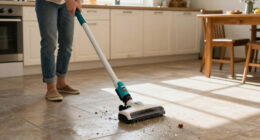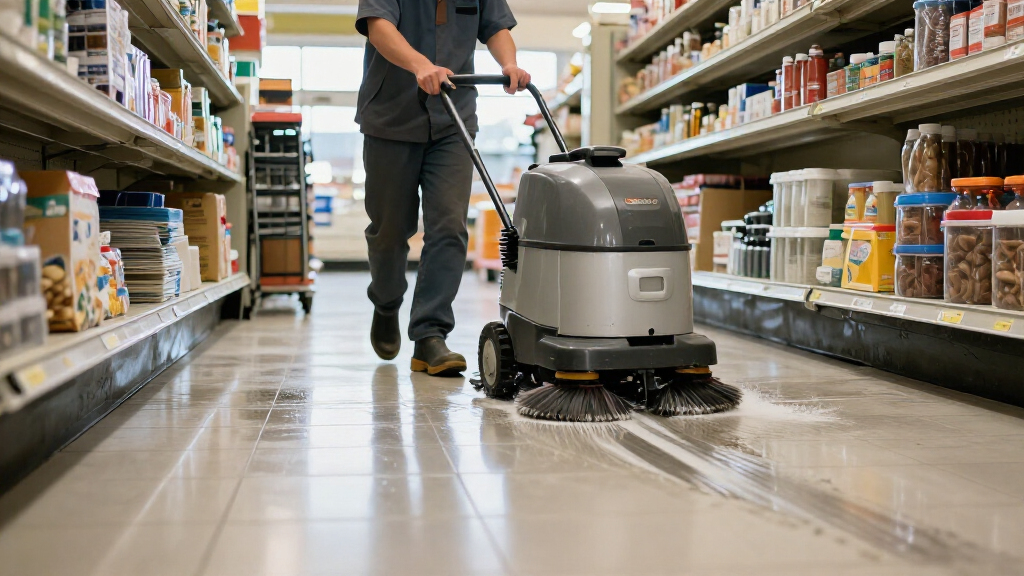
Selecting the right electric floor scrubber is less about brand loyalty and more about matching machine capacity to your specific operational needs. The primary decision tension lies between the initial capital expenditure of a ride-on model and the labor efficiency gains it provides. Walk-behind scrubbers represent the entry point for most businesses, offering a compact footprint and lower price tag. In contrast, ride-on scrubbers are industrial workhorses designed to cover vast square footage with minimal human effort. This comparison dissects the practical implications of choosing one over the other, helping facility managers determine which investment aligns with their cleaning schedules, floor types, and budget realities.

Get cleaning gear delivered free with Prime
- Fast, free delivery on millions of items
- Prime Video, Amazon Music and more included
- Member-only deals all year

Qimedo Cordless Electric Mop M3, 2-in-1 Floor Scrubber with 6000mAh Battery
- ✔ Battery capacity: 6000mAh
- ✔ Speed settings: 400, 600, and 800 RPM
- ✔ Handle length: Listed as 50 inches in description; 49 inches in title

BISSELL SpinWave Hard Floor Expert Corded Spin Mop Cleaner, Model 20393
- ✔ Model: 20393
- ✔ Power: Corded electric
- ✔ Floor compatibility: Sealed wood, tile, laminate, linoleum, rubber floor mats, and pressed wood

Bissell BigGreen Hercules Scrub and Clean Floor Machine, Green
- ✔ Brush speed: 2200 RPM
- ✔ Dimensions: 11 x 8 x 41 inches
- ✔ Weight: 8.5 pounds
At a Glance
| Criteria | Walk-Behind Electric Scrubber | Ride-On Electric Scrubber | Winner |
|---|---|---|---|
| Productivity Rate | 2,000 – 6,000 sq. ft. per hour | 8,000 – 20,000+ sq. ft. per hour | B |
| Initial Cost | $2,500 – $8,000 | $10,000 – $30,000+ | A |
| Maneuverability | Excellent for tight corners and small rooms | Limited; wide turning radius | A |
| Operator Fatigue | High; requires walking and steering | Low; seated operation | B |
| Maintenance Complexity | Simple; fewer moving parts | Complex; larger battery and drive systems | A |
| Storage Footprint | Small; fits in janitorial closets | Large; requires dedicated garage space | A |
| Battery Runtime | 1 – 3 hours depending on model size | 3 – 6 hours depending on battery pack | B |
Qimedo Cordless Electric Mop M3, 2-in-1 Floor Scrubber with 6000mAh Battery
The Qimedo M3 is our broadest-use pick because it combines powered scrubbing with cloth-based mopping instead of committing to just one cleaning style. Three speeds—400, 600, and 800 RPM—let us choose a gentler pace for routine work or a faster setting for more demanding spots. That range is a practical advantage over the BigGreen Hercules, which lists a higher 2200 RPM brush speed but is positioned as a bare-floor machine rather than a mop-and-scrubber combination.Its eight included attachments—four soft-bristle brushes and four replaceable cloth brushes—make the Qimedo more adaptable across cleaning tasks. The brush head tilts up to 45 degrees, and the telescopic handle is listed as 50 inches in the description, although the title says 49 inches. The display shows battery percentage and cleaning mode, useful details when we need to plan a longer session. An IPX7 rating is listed for the brush head, not necessarily the entire machine, so we should keep that distinction in mind.The main tradeoff is battery planning. The listed battery capacity is 6000mAh, and charging takes about 2.5 hours; the headline runtime of up to 420 minutes depends on using two batteries at low speed. That makes the cordless format convenient, but we should not assume the maximum runtime applies to one battery or high-speed scrubbing. Compared with the corded SpinWave, it can move freely from room to room, but the SpinWave specifies on-demand solution spray and floor compatibility more clearly. We would choose Qimedo for flexible household cleaning, not if we need a clearly documented, uninterrupted high-speed runtime.
Pros:
- Combines mopping and scrubbing with three speeds up to 800 RPM.
- Includes eight brush and cloth attachments for different cleaning approaches.
- Cordless design, adjustable handle, and 45-degree head angle help with reach and maneuverability.
- Display shows battery percentage and cleaning mode; brush head is listed as IPX7 waterproof.
Cons:
- The up-to-420-minute runtime claim applies to two batteries at low speed.
- The listed handle length differs between the title and description.
- The supplied details do not specify a water tank or on-demand solution spray.
Best for: Households that want one cordless machine for both powered scrubbing and cloth-based mopping, with attachments for varied tasks.
Not ideal for: Buyers who need a verified long runtime from one battery, require precise floor-compatibility guidance, or want an explicitly specified spray-control system.
Bottom line: We rank the Qimedo M3 first for its cordless two-in-one versatility, provided we treat its longest runtime as a two-battery, low-speed claim.
“We rank the Qimedo M3 first for its cordless two-in-one versatility, provided we treat its longest runtime as a two-battery, low-speed claim.”
BISSELL SpinWave Hard Floor Expert Corded Spin Mop Cleaner, Model 20393
Where the Qimedo is the flexible cordless option, the BISSELL SpinWave is the more purpose-built sealed-floor mop. Its powered pads spin against the floor, helping reduce the effort of manual scrubbing, while on-demand spray lets us apply cleaning solution where we want it rather than treating every section identically. That makes it a compelling choice for maintenance cleaning on sealed wood, tile, laminate, linoleum, rubber floor mats, and the other surfaces listed for the model.SpinWave also arrives with six washable pads: two scrubby pads and four soft-touch pads. The removable clean-water tank is easy to fill, and trial-size formulas are included. Swivel steering and a lightweight design are intended to make it easier to work around furniture and along baseboards. Compared with the Hercules, which emphasizes a compact frame, adjustable handle, bumper, and fast brush rotation, SpinWave gives us more explicit control over wet cleaning and pad choice. Compared with Qimedo, it offers clearer floor guidance and spray control but not cordless movement.The corded power is the central compromise. We need an outlet within reach and may have to reposition the cord as we move between rooms. Its use is also limited to the specified sealed hard-floor types; it is not a universal scrubber for carpet or every surface. If we have a large area with few accessible outlets or want a battery-powered tool for quick spot work, Qimedo is a more convenient fit. For regular sealed-floor cleaning where controlled solution use matters more than mobility, SpinWave is the more focused choice.
Pros:
- Powered pads provide scrubbing assistance on listed sealed hard floors.
- On-demand spray control helps limit solution to the areas being cleaned.
- Includes six washable pads in scrubby and soft-touch styles.
- Removable clean-water tank, swivel steering, and lightweight design support routine use.
Cons:
- The cord requires access to a nearby outlet and can restrict movement.
- Designed for sealed hard floors, not carpet or all floor surfaces.
- Cleaning formulas are supplied as trial sizes rather than a stated long-term supply.
Best for: People maintaining sealed hard floors who want powered washable pads, selectable scrubby or soft-touch cleaning, and controlled solution application.
Not ideal for: Buyers who need cordless movement, want to clean carpet, or have floors outside the listed sealed hard-surface compatibility.
Bottom line: We recommend SpinWave when sealed-floor compatibility and controlled pad-and-spray cleaning matter more than cordless reach.
“We recommend SpinWave when sealed-floor compatibility and controlled pad-and-spray cleaning matter more than cordless reach.”
Bissell BigGreen Hercules Scrub and Clean Floor Machine, Green
The BigGreen Hercules is the simplest, lightest machine in this comparison, weighing 8.5 pounds and measuring 11 x 8 x 41 inches. Its compact format and adjustable handle are useful when we need a maneuverable tool for bare floors, while the protective bumper helps guard edges as we work around the home. With a listed brush speed of 2200 RPM, it takes a different approach from the Qimedo’s adjustable 400-to-800-RPM range: Hercules emphasizes a fast-running floor machine rather than a multi-speed mop-and-scrubber setup.This model is designed for bare-floor scrubbing and cleaning, and the listing says it can be used on all types of bare floor surfaces. It can also be used with compatible Bissell BigGreen Commercial floor polish when a high-sheen finish is wanted. That polish-dependent result is a consideration, not an automatic benefit of the machine. Compared with SpinWave, Hercules offers a more compact, lightweight profile but does not list an on-demand spray system, a removable clean-water tank, or washable pad details. Compared with Qimedo, it is much less attachment-focused and does not offer stated cordless operation.Its narrower purpose is also its main limitation. The product is not intended for carpet, and buyers looking for the guided wet-mop approach of SpinWave or the interchangeable brush-and-cloth system of Qimedo may find the feature set too limited. The listing’s volume specification is 1 ml, which does not meaningfully clarify cleaning capacity, so we would not use it to infer tank size. We see Hercules as a practical pick for buyers who prioritize a lightweight bare-floor machine and do not need the broader controls or floor-care details provided by the other two options.
Pros:
- At 8.5 pounds, it is the lightest option with a stated weight in this lineup.
- 2200 RPM brush speed is higher than the listed speeds of the Qimedo M3.
- Adjustable handle and protective bumper support maneuvering around a home.
- Can be used with compatible floor polish when a high-sheen finish is desired.
Cons:
- Designed for bare floors rather than carpet.
- A high-sheen result depends on using compatible floor polish.
- The supplied details do not specify spray control, water-tank capacity, or cordless operation.
Best for: Buyers seeking a compact, lightweight electric floor machine for bare floors, especially where maneuverability is a priority.
Not ideal for: Anyone who needs carpet cleaning, cordless operation, explicit spray control, or a multi-attachment mop-and-scrubber system.
Bottom line: We choose Hercules for straightforward, lightweight bare-floor work, but not as a substitute for a feature-rich mop or sealed-floor spin cleaner.
“We choose Hercules for straightforward, lightweight bare-floor work, but not as a substitute for a feature-rich mop or sealed-floor spin cleaner.”
As an Amazon Associate we earn from qualifying purchases.
Key Differences
The most significant divergence between these two categories is productivity versus accessibility. A ride-on scrubber can clean a warehouse floor in a fraction of the time it takes a walk-behind unit to complete the same task. However, that speed comes at the cost of physical presence. Ride-on machines often struggle in narrow aisles, around cluttered retail displays, or in offices with frequent furniture rearrangements. Walk-behind units excel here, allowing operators to navigate complex layouts with precision. If your primary metric is square feet cleaned per labor hour, the ride-on model is the clear winner. If your metric is versatility across diverse room types, the walk-behind model holds the advantage.
Another critical distinction is the total cost of ownership. While the sticker price of a walk-behind unit is appealing, the hidden cost is labor. Cleaning 20,000 square feet with a walk-behind machine might require a full shift of manual labor, including breaks and fatigue-related slowdowns. A ride-on machine might handle the same task in two hours with a seated operator. For facilities with high labor costs, the higher initial investment in a ride-on scrubber often pays for itself within 12 to 18 months through reduced staffing hours. For smaller facilities, the capital outlay for a ride-on unit is rarely justified by the labor savings.
Detailed Comparison
Productivity and Speed (Ride-On Electric Scrubber wins — major)
Ride-on scrubbers dominate this category. Their wider cleaning paths, typically 30 to 40 inches compared to 16 to 20 inches for walk-behinds, allow them to cover ground rapidly. In a large distribution center, this difference translates to hours of saved labor each week. Walk-behind units are limited by the physical pace of the operator. While they are efficient for their size, they cannot compete with the mechanical throughput of a ride-on machine. For any facility exceeding 10,000 square feet, the productivity gap becomes the deciding factor.
Upfront Cost and Budget Impact (Walk-Behind Electric Scrubber wins — major)
Walk-behind scrubbers are significantly more affordable. A high-quality walk-behind unit can be purchased for under $5,000, making it accessible for small businesses, schools, or boutique retail spaces. Ride-on units start around $10,000 and can exceed $30,000 for heavy-duty models with lithium-ion batteries. This price difference is substantial. For a facility with a tight capital budget, the walk-behind option allows for immediate procurement without complex financing approvals. The cost of a ride-on unit often requires a formal business case demonstrating long-term labor savings.
Maneuverability and Space Constraints (Walk-Behind Electric Scrubber wins — major)
Walk-behind scrubbers win decisively in tight spaces. Their compact size allows them to clean between shelving units, around office desks, and in narrow hallways. Ride-on scrubbers have a wide turning radius and a broad body that simply cannot fit into many commercial environments. If your floor plan includes many obstacles, small rooms, or irregular shapes, a ride-on machine will spend more time navigating than cleaning. Walk-behind units offer the flexibility to clean effectively in these confined areas without needing a second backup machine.
Operator Ergonomics and Fatigue (Ride-On Electric Scrubber wins — moderate)
Ride-on scrubbers drastically reduce physical strain. The operator sits, controls the machine with a steering wheel, and experiences minimal vibration. This is critical for long shifts or facilities with aging staff. Walk-behind scrubbers require the operator to walk behind the machine, push it through turns, and manage controls while standing. Over an eight-hour shift, this leads to significant fatigue, which can reduce cleaning quality toward the end of the day. For labor-intensive cleaning schedules, the ergonomic advantage of the ride-on unit improves worker retention and consistent output.
Maintenance and Repair Complexity (Walk-Behind Electric Scrubber wins — moderate)
Walk-behind units are mechanically simpler. They have fewer motors, smaller batteries, and less complex drive systems. Repairs are often quicker and cheaper because parts are standardized and less expensive. Ride-on scrubbers involve larger drive motors, complex steering mechanisms, and massive battery packs. When a ride-on unit fails, it can take the entire cleaning operation offline for days while specialized technicians and expensive parts are sourced. For facilities without in-house maintenance staff, the simplicity of walk-behind machines reduces downtime risk.
Storage and Footprint (Walk-Behind Electric Scrubber wins — moderate)
Walk-behind scrubbers can be stored in standard janitorial closets or small utility rooms. They are lightweight enough to be moved by one person. Ride-on scrubbers require significant floor space, often comparable to a small car. They also require heavy-duty charging stations and potentially reinforced flooring if used in older buildings. For facilities with limited storage infrastructure, accommodating a ride-on machine can be a logistical nightmare. Walk-behind units integrate seamlessly into existing spaces without renovation or dedicated parking spots.
Walk-Behind Electric Scrubber: Pros and Cons
Pros:
- Lower initial purchase price
- Highly maneuverable in tight spaces
- Easier to store in small closets
- Simpler maintenance and lower repair costs
- Lower training requirements for staff
Cons:
- Lower productivity per hour
- High operator fatigue during long shifts
- Limited battery runtime for large areas
- Not suitable for industrial-grade debris
- Requires more labor hours to complete tasks
Ride-On Electric Scrubber: Pros and Cons
Pros:
- Extremely high productivity rates
- Reduces operator fatigue significantly
- Larger tank capacity means fewer stops
- Handles large, open floor plans efficiently
- Better for consistent cleaning quality over long shifts
Cons:
- High upfront capital cost
- Cannot navigate tight aisles or small rooms
- Requires significant storage space
- Higher maintenance costs and complexity
- Overkill for facilities under 5,000 sq. ft.
Who Should Choose What
Choose Walk-Behind Electric Scrubber if:
- Your facility is under 10,000 square feet.
- You have narrow aisles, cluttered retail displays, or many small rooms.
- Your budget is limited and you prefer lower upfront costs.
- You have limited storage space for equipment.
- Cleaning tasks are intermittent rather than continuous all-day operations.
Choose Ride-On Electric Scrubber if:
- Your facility exceeds 15,000 square feet of open floor space.
- You have high labor costs and need to maximize productivity.
- You operate in large warehouses, airports, or big-box retail stores.
- You have dedicated storage and charging infrastructure.
- You require consistent cleaning quality over long shifts with minimal operator fatigue.
Skip both if: If your floors are heavily carpeted, you should consider commercial vacuum cleaners instead, as neither scrubber type is designed for deep carpet cleaning.
Value for Money
Is the premium price of a ride-on scrubber worth it? The answer depends entirely on your labor economics. If you pay minimum wage and have abundant staff, a walk-behind scrubber is the better value because the labor savings do not justify the $15,000+ capital expenditure. However, in markets with high labor costs or shortages, the ride-on scrubber offers superior value. By reducing the time required to clean a facility by 50 percent or more, a ride-on unit can pay for itself in labor savings within the first year. For large facilities, the cost per square foot cleaned is significantly lower with a ride-on machine when factoring in wages, benefits, and supervision time.
Final Verdict
For most small to mid-sized businesses, the walk-behind electric scrubber is the pragmatic choice. It offers sufficient power for daily tasks, fits into existing spaces, and avoids the complexity of heavy machinery. However, if you are managing a large, open industrial or commercial space, sticking with walk-behind units is a false economy. The labor hours saved by a ride-on scrubber will quickly outweigh its higher purchase price. Choose the walk-behind unit for versatility and budget control. Choose the ride-on unit for scale and efficiency. The biggest deciding factor is not the machine itself, but the square footage of open floor space you need to clean every day.
Frequently Asked Questions
Can I use a ride-on scrubber in a small office?
Generally, no. Ride-on scrubbers are too wide to navigate hallways and office layouts. They will likely damage furniture and walls while failing to clean effectively in tight corners. A walk-behind unit is the appropriate choice for office environments.
How long do electric scrubber batteries last?
Walk-behind units typically run for 1 to 3 hours per charge. Ride-on units can run for 3 to 6 hours, depending on the battery pack size. Lithium-ion batteries offer longer life and faster charging compared to traditional lead-acid batteries, but they cost more upfront.
Do I need special training to operate a ride-on scrubber?
Yes, most safety regulations require specific training for operating ride-on equipment, similar to forklifts. Operators must understand steering, braking, and emergency shut-off procedures. Walk-behind units require less formal training but still need instruction on proper usage and maintenance.
Which type is better for hard floors like tile or concrete?
Both types work well on hard floors. The choice depends on the area size. For a small tile lobby, a walk-behind is ideal. For a large concrete warehouse, a ride-on scrubber with heavy-duty pads is necessary to handle the volume and debris effectively.