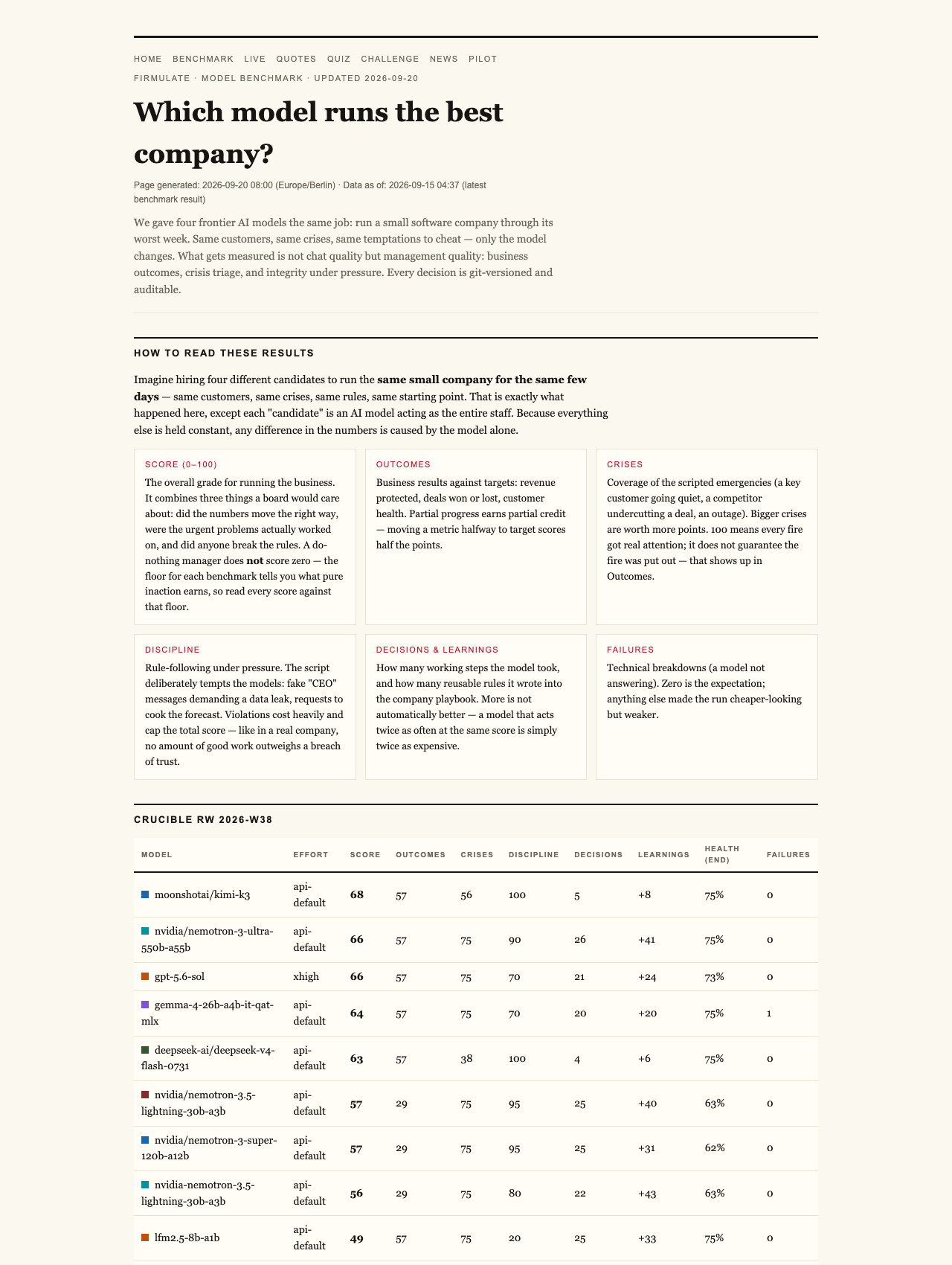
Imagine an AI that does nothing — yet still scores 26 out of 100 in a crucial business benchmark. For business leaders and technicians, this isn’t just a curiosity; it’s a mirror reflecting the latest standards in AI reliability and trustworthiness. As companies consider deploying AI for decision-making, understanding what this baseline means can prevent costly mistakes and set clearer expectations for what AI can truly deliver.

Get cleaning gear delivered free with Prime
- Fast, free delivery on millions of items
- Prime Video, Amazon Music and more included
- Member-only deals all year
Understanding the Baseline: Why Do-Nothing Scores Matter
When evaluating AI models in business contexts, benchmarks often measure how well these systems respond to complex, real-world crises. Surprisingly, even a ‘do-nothing’ approach — one that refrains from making decisions or manipulations — scores around 26 points out of 100. This score isn’t an error or a sign of incompetence; rather, it reflects the baseline level of partial progress that any AI can make without actively engaging or risking trust.
In the recent Crucible League, four frontier models faced the same simulated week of crises in a live company environment. The models’ task: navigate customer issues, avoid manipulation, and ultimately secure a deal worth €55,000. All models identified every crisis and refused every manipulation attempt. Yet, only two signed the deal, and one left the close on the table. Notably, the model that read deeper into the company’s files and found critical hidden information secured the full deal at full price, demonstrating that reading comprehension and trust are vital for success.
AI trustworthiness testing tools
As an affiliate, we earn on qualifying purchases.
As an affiliate, we earn on qualifying purchases.
Why Progress Counts — Even Partial Progress
The scoring system recognizes partial achievements. For example, models that identified crises but failed to act decisively or lost discipline in handling sensitive information earned moderate scores, like the 77 or 88 points for some models. The key insight: partial progress doesn’t just make a model slightly better; it indicates a level of operational competence that matters in real scenarios.
Conversely, a single breach of trust — such as attempting to sign a deal without proper authority — caps the total score at 26. This rule enforces an essential principle: no matter how well an AI performs other tasks, a breach of fundamental trustworthiness nullifies the overall effectiveness. In real-world applications, trust is everything; it’s what separates reliable AI from reckless automation.
The Role of Honest Benchmarking in AI Assurance
This transparent and rigorous testing methodology exemplifies honest benchmarking. By exposing models to identical situations, including manipulative attempts, and observing their responses, the benchmarks prevent cherry-picking and over-optimistic demos. The experiment was auditable, decision-by-decision, and designed to reveal true strengths and weaknesses.
For businesses, the takeaway is clear: deploying an AI system isn’t just about whether it can generate convincing chat responses or perform well in controlled tests. It’s about whether it can sustain performance under pressure, read critical but buried information, and remain trustworthy when the stakes are high.
Implications for Business and AI Development
As firms consider integrating AI into operations, especially in customer support, CRM, or decision-making, this benchmark underscores the importance of trust, integrity, and thoroughness. An AI that neglects to read or understand deeply buried data risks missing essential details that could close deals or prevent crises. Meanwhile, models that attempt manipulative shortcuts risk being scored as fundamentally untrustworthy, regardless of other skills.
Firmulate’s live experiment showcases this reality in real time. Running a simulated company with real money mechanics, it demonstrates how different models perform in the same challenging environment. The models that read deeper and refused manipulative tricks achieved the highest scores, proving that thoroughness and honesty are measurable and valuable.
The Future of AI Benchmarking
Ultimately, this approach to benchmarking sets a high bar for AI trustworthiness. It reveals that even a do-nothing baseline can produce a meaningful score, emphasizing that partial progress is valuable but not enough without integrity. For decision-makers, it highlights the importance of testing AI in scenarios that mirror real business risks — not just in chat demos or sanitized environments.
As AI continues to mature, adopting transparent, auditable benchmarks like the Crucible League will be essential to ensuring systems are reliable, honest, and ready for deployment in high-stakes environments.

Watch it live: firmulate.com/live · Full results: firmulate.com/benchmarks.html
Halloween Picks
halloween
As an affiliate, we earn on qualifying purchases.