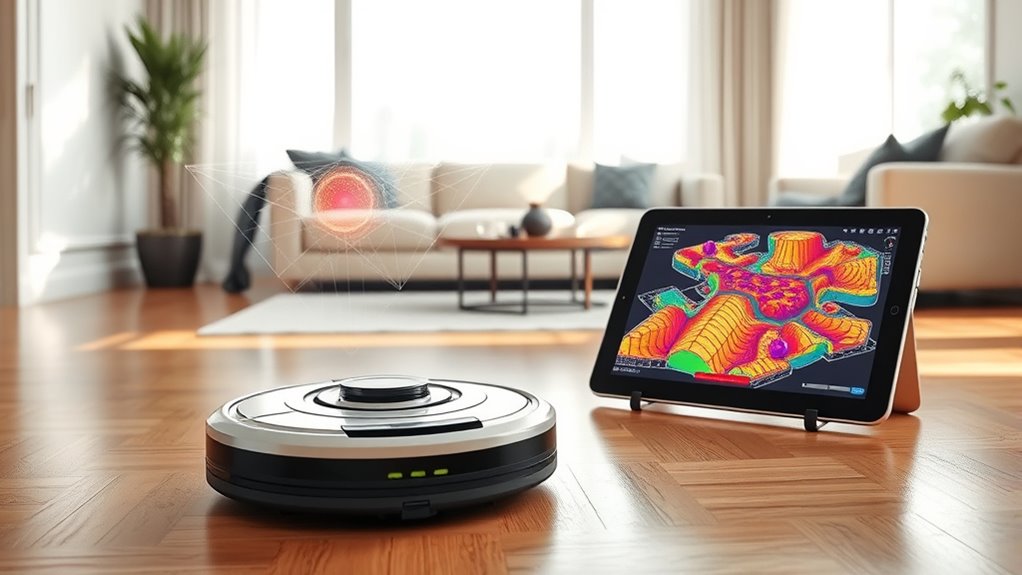

Lidar, vision, and SLAM are the core technologies that make robotic cleaners smart and efficient. Lidar provides precise distance and 3D mapping, while cameras add contextual details like textures and objects. SLAM helps the robot build maps of your space while tracking its position in real-time. Combining these tools through sensor fusion improves accuracy, allowing your cleaner to navigate obstacles smoothly and adapt to changes. Keep exploring to understand how these systems truly work together.
Key Takeaways
- Lidar provides accurate distance measurements and 3D environmental mapping for precise navigation.
- Vision sensors add contextual information like object recognition and textures to enhance understanding.
- SLAM enables real-time mapping and localization, allowing robots to navigate and update maps simultaneously.
- Sensor fusion combines lidar, vision, and inertial data to improve environmental accuracy and robustness.
- These technologies collectively enable robotic cleaners to navigate efficiently, avoid obstacles, and adapt to changing environments.

Lidar, vision, and SLAM are key technologies driving advancements in autonomous navigation. When you’re working with robotic cleaners or autonomous devices, these tools form the backbone of how they understand and move through their environment. At the heart of this process are sophisticated mapping algorithms that process data from various sensors, creating detailed maps of the surroundings. These algorithms analyze the raw data to identify obstacles, free space, and important features, ensuring the robot knows where it is and how to reach its destination efficiently.
Sensor fusion plays a vital role here, combining inputs from multiple sensors like lidar, cameras, and inertial measurement units. This integration allows the system to compensate for the limitations of individual sensors, resulting in a more accurate and reliable environmental model. For example, lidar provides precise distance measurements and 3D mapping, while vision sensors add contextual information like object recognition and texture details. When you fuse this data, the robot gains a thorough understanding of its environment, which improves navigation, obstacle avoidance, and mapping accuracy.
Sensor fusion combines lidar, cameras, and inertial sensors for accurate, reliable environmental understanding.
SLAM, or Simultaneous Localization and Mapping, is the process that enables the robot to build a map of an unknown environment while tracking its position within it. You can think of it as a real-time feedback loop: as the robot moves, it updates its map based on sensor data, constantly refining its understanding of the space. Advanced mapping algorithms leverage sensor fusion to enhance SLAM’s performance, ensuring the robot can operate smoothly even in complex or dynamic environments. This continuous process allows robotic cleaners to adapt to changes, recognize previously visited areas, and optimize their cleaning paths without human intervention.
In practical terms, these technologies mean your robotic cleaner can efficiently navigate around furniture, avoid obstacles, and clean thoroughly without getting stuck or lost. The integration of mapping algorithms and sensor fusion makes the system robust against environmental variations, such as changes in lighting or clutter. Instead of relying on a single sensor type, the robot intelligently combines data streams, resulting in a detailed, accurate map that guides its movements. This synergy of lidar, vision, and SLAM not only improves the cleaning efficiency but also extends the operational lifespan of autonomous devices by reducing errors and the need for manual recalibration.
Frequently Asked Questions
How Do Robotic Cleaners Handle Dynamic Obstacles?
You can trust your robotic cleaner to handle dynamic obstacles effectively by relying on obstacle avoidance and real-time mapping. As it detects moving objects, it quickly adjusts its path to avoid collisions, ensuring thorough cleaning without interruptions. The robot constantly updates its map of the environment, allowing it to navigate around pets, people, or furniture that move unexpectedly. This proactive approach keeps your space clean and safe.
What Are the Limitations of Current SLAM Algorithms?
Imagine steering through a maze with a foggy map—that’s what current SLAM algorithms face. Their limitations often stem from sensor fusion challenges and inconsistent algorithm robustness, especially in complex or changing environments. They struggle with dynamic obstacles, poor lighting, or featureless areas, making localization tricky. To improve, developers need to enhance sensor integration and create more adaptable algorithms that can handle unpredictable real-world conditions effectively.
How Do Sensors Perform in Varying Lighting Conditions?
Your sensors can struggle in varying lighting conditions, especially if there’s poor illumination or strong ambient interference. This affects sensor calibration, causing inaccuracies in data collection. Bright lights or reflective surfaces can also distort sensor readings, making navigation difficult. To improve performance, you need to regularly calibrate your sensors and minimize ambient interference, ensuring your robotic cleaner maintains accurate perception regardless of changing lighting environments.
What Is the Cost Difference Between Lidar and Vision Systems?
Think of lidar as a luxury sports car and vision systems as reliable family sedans—lidar costs considerably more, often by thousands of dollars. You’ll need sensor calibration and data fusion to integrate both, but the price gap remains. While lidar offers precision, vision systems are more budget-friendly. Your choice hinges on your budget and how much you value accuracy versus affordability.
How Do Robotic Cleaners Update Maps Over Time?
You update robotic cleaners’ maps over time by continuously collecting sensor data, which helps improve mapping accuracy. They use algorithms that incorporate new information while accounting for sensor calibration to correct any inaccuracies. This process allows the robot to adapt to changes in the environment, refine its map, and navigate more effectively. Regular updates ensure your cleaner maintains ideal performance, even as your space evolves.
Conclusion
Now, you’ve seen how lidar, vision, and SLAM work together to create smarter robotic cleaners. But as technology advances, what new innovations could revolutionize your experience even further? Will future robots navigate with flawless precision or uncover secrets we haven’t imagined? The possibilities are endless, and the next breakthrough might be just around the corner. Stay tuned—because what’s coming next could change the way you see cleaning forever.