
TL;DR

Get cleaning gear delivered free with Prime
- Fast, free delivery on millions of items
- Prime Video, Amazon Music and more included
- Member-only deals all year
A House Beautiful report describes designers using decorative marbling across wallpaper, murals, furniture, textiles and lighting in 2026 interiors. Designers interviewed for the report say its handmade, non-repeating patterns can add color and character, though the examples do not establish how widespread the trend is.
Designers are bringing decorative marbling to walls, furniture, textiles and lighting, according to a House Beautiful report on interiors in 2026. The examples show the heritage technique being used in both large-scale installations and smaller accents, offering an alternative to plain, neutral finishes without indicating that the look has replaced them across the industry.
The report describes projects using marbled effects in wallpaper and murals, along with resin chairs, lampshades, upholstery and other decorative elements. Designer Michelle Fahmy used a large-scale marbled wallpaper mural in a stairwell that opens into a living room, choosing it as a prominent feature at the home’s entrance. Sasha Bikoff used flowing, liquid-like wallpaper in a project inside a Zaha Hadid-designed building.
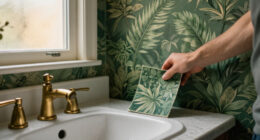
Other examples use the pattern to coordinate a room. Marta St. Amour selected Lee Jofa’s Taplow wallpaper as the starting point for a bathroom palette, pairing its amber, blue and beige tones with quartzite and tile. Analisse Taft-Gersten used marbled silk for a powder-room sink skirt, while Bikoff also chose resin chairs with swirling color. The report notes that marbling can appear on lampshades as a smaller-scale option.
Designers quoted in the article describe the appeal as a combination of movement, craft and variation. Cara Woodhouse said clients want surfaces with more character after years of greige, while Jo Plant of lighting brand Pooky said people are seeking pieces that feel handmade rather than mass-produced. These are designers’ observations, not survey findings or evidence of sales growth.
Marbling Moves Beyond Wallpaper
The examples matter to homeowners and design professionals because they show how one recognizable technique can be adapted to different budgets, surfaces and levels of commitment. A mural or full-wall paper makes a stronger visual statement; a lampshade, chair or textile offers a smaller way to introduce irregular color and pattern. That flexibility may help readers judge whether the look suits a room without assuming every surface needs a makeover.
Marbling’s irregular lines also distinguish it from a pattern built around exact repeats. Woodhouse described the result as more like art than conventional wallpaper, with variation from one pass to the next. In practical design terms, the report’s projects use that movement in different ways: to echo architectural forms, establish a color palette or add contrast to otherwise restrained finishes.
Products Worth Considering

Levoit Core 400S-P Smart Air Purifier for Large Rooms

eufy E25 Robot Vacuum and Mop Combo with HydroJet Roller Mop

Philips Hue Secure Wired Video Doorbell, 2K, Black
As an affiliate, we earn on qualifying purchases.
A Pattern With Centuries of History
Decorative marbling has a long history as a method for creating patterns by manipulating color on water and transferring the resulting design. The report traces an early form to 10th-century Japan, where artisans made “floating ink” designs, and says the practice was known in 15th-century Turkey as “the art of clouds.” It later reached Venetian and Florentine bookbinders.
The current examples extend the technique beyond paper. Bikoff said the important feature is the movement of color and organic pattern, which can translate to wallpaper, furniture, textiles and decorative objects. The report links interest in heritage looks to a desire for interiors that feel personal and crafted, but presents that as designers’ explanation rather than a measured account of consumer behavior.
“People are tired of flat, safe walls.”
— Cara Woodhouse, designer
How Broad Is the Design Shift?
The report offers designer interviews and project examples, not market data, a consumer survey or evidence that marbling is replacing beige walls at scale. It does not quantify how many designers or homeowners are adopting the look, nor compare its popularity with other finishes. The headline’s replacement framing is therefore broader than the evidence presented in the article.
It is also unclear whether the interest will persist beyond the projects described. The report does not provide pricing, product availability across the featured applications, or performance details such as durability and maintenance for particular materials. Those factors will vary by product and installation.
Watch for Broader Adoption
The report does not identify a scheduled next announcement or industry milestone. Readers considering the look can compare the specific materials and applications shown, from wallpaper to accessories, and ask designers or suppliers about samples, installation and care before committing. For the broader trend, market data and additional reporting would be needed to show whether these examples reflect wider adoption or remain individual design projects.
Key Questions
What is decorative marbling?
Decorative marbling creates flowing, irregular color patterns inspired by designs made by manipulating pigment on water. In current interiors, the effect can be printed, painted or incorporated into materials such as resin and textiles.
Where are designers using marbling?
The House Beautiful report shows marbling on wallpaper and murals, resin chairs, lampshades, silk and other textiles. The examples range from prominent wall treatments to small decorative accents.
Does the report prove marbling is replacing beige walls?
No. It provides designer commentary and selected project examples, but no market figures or survey data showing that marbling is broadly replacing neutral finishes.
How can someone try the look without covering a wall?
The report points to smaller accents such as a marbled lampshade as one option. A chair or decorative object can also introduce the pattern without making it the dominant finish in a room.
Source: housebeautiful.com