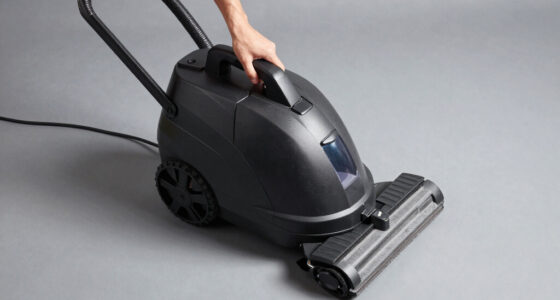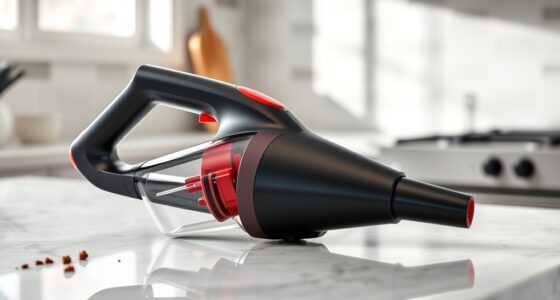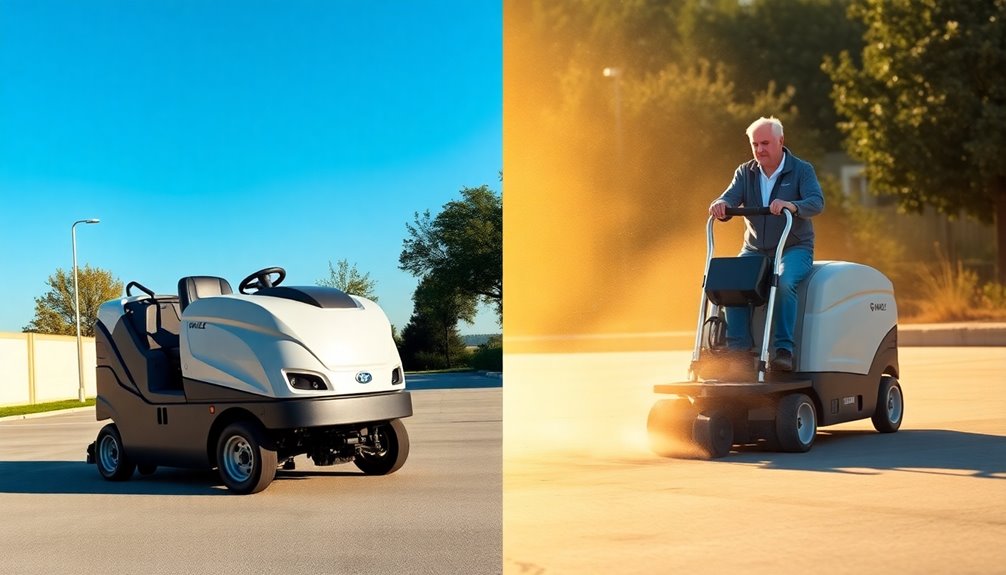

For large warehouses and factories, I’d choose the E8 51-Inch Ride-On Commercial Floor Sweeper as the best overall pick for its wide cleaning path; the Kärcher S 4 Twin suits lighter outdoor cleanup, while the VEVOR 25.6-Inch Manual Walk-Behind keeps small jobs simple. The main tradeoff is coverage versus maneuverability: ride-on machines reduce operator effort across broad floors, while walk-behind models need less space and can suit tighter routes. Power source, debris capacity, and upkeep also affect which style makes sense for a given site. I compare all 15 options by their intended use and practical tradeoffs below. Continue reading for the full breakdown and help matching a sweeper to your floor plan.

Get cleaning gear delivered free with Prime
- Fast, free delivery on millions of items
- Prime Video, Amazon Music and more included
- Member-only deals all year
Complete the kit


Key Takeaways
- Ride-on models dominate broad commercial floors: Several picks have brush widths around 49 to 51 inches, making them better suited to open warehouse routes than narrow aisles.
- Walk-behind models suit tighter spaces: The VEVOR and Kärcher offer more manageable formats for smaller areas, though manual operation takes more effort over long routes.
- Capacity matters alongside cleaning width: Ride-on options list bins from 25 to 27 gallons, while the Liberty LS-WS1400 lists a 120-liter capacity; larger bins can reduce stops but add to the machine’s size.
- The 41-inch battery-powered sweeper occupies a useful middle ground: It offers a wider path and powered operation without the ride-on format, though buyers should confirm runtime and charging needs for their workload.
- Many ride-on listings have closely matched headline specs: When brush widths and stated coverage look similar, buyers should compare support, dimensions, controls, and maintenance details rather than rank by width alone.
| E8 51-Inch Ride-On Commercial Floor Sweeper |  | Best Overall for Large Facilities | Cleaning path: 51 inches | Main brush: 20-inch cylindrical brush | Side brushes: Two 19.69-inch brushes | VIEW ON AMAZON | See Our Full Breakdown |
| VEVOR Manual Walk-Behind Floor Sweeper, 25.6-Inch Sweeping Width |  | Best Value for Smaller Sites | Power source: Manual, non-electric | Sweeping width: 25.6 inches | Waste container capacity: 5 gallons | VIEW ON AMAZON | See Our Full Breakdown |
| KARHDIR 51″ Ride-on Industrial Floor Sweeper, 92,600 Sqft/h, Gray |  | Best for Sloped Industrial Sites | Cleaning path width: 50.4 inches | Cleaning rate: Up to 92,600 sq ft per hour | Hopper capacity: 26.4 gallons | VIEW ON AMAZON | See Our Full Breakdown |
| HO1280 51″ Commercial Ride-On Floor Sweeper |  | Best for Full-Shift Commercial Sweeping | Cleaning path width: 51 inches | Cleaning rate: 92,600 sq ft per hour | Top speed: 8.7 MPH | VIEW ON AMAZON | See Our Full Breakdown |
| 41.3-Inch Battery-Powered Walk-Behind Floor Sweeper with Triple Brush |  | Best Wide-Path Walk-Behind | Cleaning width: 41 inches | Brush system: Triple brush with dual side brushes | Hopper capacity: 9.25 gallons | VIEW ON AMAZON | See Our Full Breakdown |
| KARHDIR Ride-On Floor Sweeper, 50.4-Inch Cleaning Width |  | Best for Long Cleaning Runs | Cleaning width: 50.4 inches | Cleaning rate: Over 92,600 sq. ft./h | Battery: 48 V, 45 Ah lithium | VIEW ON AMAZON | See Our Full Breakdown |
| Ride-On Floor Sweeper Machine, 51″ Brush Width, 92,600 Sq ft/h, 26.5 Gal Dustbin, 800W Brushless Motor, Grey |  | Best for Dust-Controlled Sweeping | Brush width: 51 inches | Cleaning efficiency: 92,600 sq ft/h | Dustbin capacity: 26.5 gallons | VIEW ON AMAZON | See Our Full Breakdown |
| Industrial Ride-On Floor Sweeper for Warehouses and Factories |  | Best for Operator Comfort and Maneuvering | Work efficiency: Up to 10,000 m³/h | Cleaning path width: 1250 mm | Solution tank capacity: 65 L | VIEW ON AMAZON | See Our Full Breakdown |
| 51″ Commercial Ride-On Floor Sweeper with 27 Gal Dustbin |  | Best for Uneven Outdoor Routes | Cleaning path width: 51 inches | Cleaning rate: 92,600 sq ft/hr | Motor power: 800 W | VIEW ON AMAZON | See Our Full Breakdown |
| 49-Inch Ride-On Floor Sweeper with 26-Gallon Hopper |  | Best for Shorter, Predictable Shifts | Cleaning width: 49 inches | Debris hopper capacity: 26 gallons | Water tank capacity: 12.68 gallons | VIEW ON AMAZON | See Our Full Breakdown |
| Kärcher S 4 Twin Walk-Behind Outdoor Push Sweeper |  | Best for Quiet Small-Site Cleanup | Sweeping width: 26.8 inches | Waste container: 5.25 gallons | Coverage rate: Up to 26,000 sq ft per hour | VIEW ON AMAZON | See Our Full Breakdown |
| Commercial Ride-On Floor Sweeper, 49″ Brush Width, 25 Gal Dustbin |  | Best for Short, High-Volume Shifts | Brush width: 49 inches | Cleaning rate: Up to 77,500 sq ft/hr | Dustbin capacity: 25 gallons | VIEW ON AMAZON | See Our Full Breakdown |
| 51″ Ride-On Industrial Floor Sweeper Machine |  | Best for Maximum Stated Coverage | Cleaning path: 51 inches | Main brush power: 800W | Battery: 48V maintenance-free | VIEW ON AMAZON | See Our Full Breakdown |
| 41-Inch Industrial Manual Push Floor Sweeper |  | Best Manual Pick for Broad Flat Areas | Sweeping path: 41 inches | Waste bin capacity: 14.5 gallons | Brush system: Height-adjustable three-brush system with dual side brushes | VIEW ON AMAZON | See Our Full Breakdown |
| Liberty LS-WS1400 Ride-On Industrial Floor Sweeper, 120L Capacity, Blue |  | Best for Dust-Controlled Facility Cleaning | Model: LS-WS1400 | Type: Ride-on electric floor sweeper | Hopper capacity: 120L | VIEW ON AMAZON | See Our Full Breakdown |
More Details on Our Top Picks
E8 51-Inch Ride-On Commercial Floor Sweeper
The E8 makes the most sense when a facility’s size makes walking behind a sweeper inefficient. Its 51-inch cleaning path, 27-gallon hopper, and up to 3.5 hours of runtime support long passes across large indoor or outdoor areas, while the 11-gallon misting tank helps control dust. Compared with the VEVOR Manual Walk-Behind Floor Sweeper, it covers much more ground with less pushing, but calls for more space and a full charge can take 7–8 hours. The KARHDIR and HO1280 ride-ons also claim cleaning rates up to 92,600 square feet per hour; the E8’s stated runtime gives buyers a clearer operating-time figure. This is a dry sweeper, so it cannot replace equipment for washing or mopping floors.
Pros:- 51-inch path and 27-gallon hopper support long cleaning runs across large areas.
- Up to 3.5 hours of runtime is specified, helping teams plan a shift.
- 11-gallon misting tank helps suppress dust during dry sweeping.
- Designed for indoor and outdoor use.
Cons:- Does not wash, mop, or scrub floors.
- A 7–8-hour charge can limit turnaround between shifts.
- Ride-on size requires more storage space than a walk-behind sweeper.
Best for: Facility teams covering large warehouses, outdoor lots, or other broad areas that need a ride-on sweeper with a stated runtime.
Not ideal for: Small shops or cleaning teams that need floor washing, have limited machine storage, or cannot plan around a 7–8-hour charge.
- Cleaning path:51 inches
- Main brush:20-inch cylindrical brush
- Side brushes:Two 19.69-inch brushes
- Debris hopper:27 gallons
- Dust suppression tank:11 gallons
- Total motor power:1600 W
- Runtime:Up to 3.5 hours
- Charging time:7–8 hours
- Function:Dry sweeping with dust suppression; no washing or mopping
Our verdict“Choose the E8 for broad areas where ride-on coverage and a stated 3.5-hour runtime matter more than compact storage or floor washing.”
VEVOR Manual Walk-Behind Floor Sweeper, 25.6-Inch Sweeping Width
The VEVOR is the practical walk-behind choice for buyers who need broad sweeping coverage without a powered ride-on machine. Its 25.6-inch path and 5-gallon waste container mean fewer passes and fewer stops to empty than a narrow manual sweeper, while the foldable, adjustable handle helps it fit into tighter storage. Compared with the E8 51-Inch Ride-On Commercial Floor Sweeper, it demands more effort and covers less ground per pass, but avoids battery charging and is better suited to garages, patios, and walkways. That tradeoff makes it a sensible fit for property owners or small crews with modest areas. Assembly is required, and pushing it across a large facility can become tiring; buyers with extensive grounds should look at a ride-on instead.
Pros:- 25.6-inch sweeping width covers more ground per pass than a narrow push sweeper.
- 5-gallon waste container reduces emptying stops for a manual model.
- Adjustable handle accommodates different users and working positions.
- Foldable handle helps reduce storage space.
Cons:- Manual pushing requires physical effort, especially across large areas.
- Assembly is required.
- Covers far less ground per pass than the E8 ride-on.
Best for: Homeowners and small property crews sweeping patios, driveways, walkways, or garages who prefer manual equipment and compact storage.
Not ideal for: Warehouse teams or operators covering extensive grounds, where pushing a manual sweeper would take too much time and effort.
- Power source:Manual, non-electric
- Sweeping width:25.6 inches
- Waste container capacity:5 gallons
- Handle:Adjustable angle and height; foldable
- Recommended surfaces:Walkway, yard, garage, patio
- Operation:Push-operated
Our verdict“Pick the VEVOR for smaller properties where simple manual sweeping and foldaway storage matter more than ride-on speed.”
KARHDIR 51″ Ride-on Industrial Floor Sweeper, 92,600 Sqft/h, Gray
The KARHDIR is aimed at demanding industrial grounds where incline handling matters alongside sweeping width. Its 50.4-inch path, claimed rate of up to 92,600 square feet per hour, and 35-degree maximum slope suit warehouses, factories, and parking lots with varied terrain. Solid tires and hydraulic disc brakes add practical control for a machine that weighs 968 pounds. Compared with the HO1280 51″ Commercial Ride-On Floor Sweeper, the KARHDIR lists a slightly narrower path but specifies an 800W brushless main-brush motor and slope capability; the HO1280 provides clearer battery and water-tank details. The KARHDIR’s weight also makes transport and storage a serious planning issue. Its performance claims are compelling, but operating runtime is not provided in the supplied specifications.
Pros:- 50.4-inch path and stated cleaning rate target large-area coverage.
- 35-degree maximum slope is suited to sites with significant inclines.
- Solid tires and hydraulic disc brakes are specified for industrial handling.
- 800W brushless main-brush motor is specified.
Cons:- At 968 pounds, it requires substantial storage space and planning to move.
- Runtime is not specified in the provided product data.
- The 26.4-gallon hopper is slightly smaller than the HO1280’s 27-gallon capacity.
Best for: Industrial cleaning teams with large sites that include slopes and need a ride-on sweeper with specified braking and tire details.
Not ideal for: Small facilities or buyers who need a compact machine, a stated runtime, or a lighter unit that is easier to move and store.
- Cleaning path width:50.4 inches
- Cleaning rate:Up to 92,600 sq ft per hour
- Hopper capacity:26.4 gallons
- Main brush motor:800W brushless
- Maximum slope:35 degrees
- Dimensions:40.55 x 64.17 x 53.94 inches
- Weight:968 pounds
- Tires and brakes:Three large solid tires; hydraulic disc brakes
Our verdict“Choose the KARHDIR for large industrial sites with slopes, provided its weight and unspecified runtime fit your operation.”
HO1280 51″ Commercial Ride-On Floor Sweeper
The HO1280 gives commercial crews a broad ride-on platform with useful capacity details for planning routine dry sweeping. Its 51-inch path, 27-gallon hopper, and 10.5-gallon water tank pair high-area coverage with dust suppression; a maintenance-free 48V battery avoids the upkeep associated with some battery setups. Compared with the E8 51-Inch Ride-On Commercial Floor Sweeper, the HO1280 lists a top speed and 35-degree incline capability, while the E8 provides a specific runtime of up to 3.5 hours. The HO1280’s description says full-shift runtime but does not give a duration, so buyers should verify that claim against their route and work schedule. Like the other ride-ons here, it needs ample storage and only sweeps dry debris; it will not scrub or mop a floor.
Pros:- 51-inch cleaning path and 27-gallon hopper support high-volume sweeping.
- 10.5-gallon spray tank helps suppress dust.
- 48V maintenance-free battery is designed to reduce battery upkeep.
- Specifies top speed and incline capability for route planning.
Cons:- Dry sweeping only; it cannot wash, mop, or scrub floors.
- Large ride-on form requires substantial storage space.
- The supplied specs do not state a runtime duration.
Best for: Commercial cleaning managers seeking a wide-path ride-on with a large hopper, dust suppression, and maintenance-free battery design.
Not ideal for: Small operations that lack room for a ride-on or need a stated runtime before planning shift coverage.
- Cleaning path width:51 inches
- Cleaning rate:92,600 sq ft per hour
- Top speed:8.7 MPH
- Debris hopper capacity:27 gallons
- Water tank capacity:10.5 gallons
- Main brush power:800W
- Maximum incline:35 degrees
- Battery:48V maintenance-free
- Function:Dry sweeping with dust suppression; no washing or mopping
Our verdict“The HO1280 suits commercial teams wanting broad, dust-suppressed dry sweeping, as long as its claimed full-shift battery runtime is confirmed for their needs.”
41.3-Inch Battery-Powered Walk-Behind Floor Sweeper with Triple Brush
This battery-powered walk-behind bridges the gap between manual push sweepers and the much wider ride-ons in this roundup. Its 41-inch cleaning width, triple-brush setup, and 9.25-gallon hopper let a walking operator cover more ground and collect more debris per run than the VEVOR’s 25.6-inch manual model. The 12V battery also avoids the physical pushing required by that VEVOR, while keeping the operator on foot rather than seated on a large machine like the HO1280. That middle ground can suit commercial spaces where a ride-on feels too large. The limitation is planning: the supplied data gives no battery runtime, dimensions, or weight. Buyers who need predictable shift coverage or want the fastest coverage across a vast site should favor a ride-on with better-documented operating details.
Pros:- 41-inch cleaning width covers substantially more ground per pass than the VEVOR manual sweeper.
- Triple-brush system with dual side brushes supports debris collection across a broad path.
- 9.25-gallon hopper allows more collection before emptying than the VEVOR’s 5-gallon container.
- Battery-powered operation produces no fumes, and the handle is adjustable.
Cons:- Battery runtime and capacity are not specified.
- Dimensions and weight are not provided, making storage and handling harder to assess.
- Walking operation is slower across vast areas than using a ride-on such as the HO1280.
Best for: Commercial cleaning crews that need a wide walk-behind for indoor and outdoor areas but cannot use or store a ride-on machine.
Not ideal for: Teams covering very large sites or requiring known runtime, dimensions, and weight to plan routes and shifts.
- Cleaning width:41 inches
- Brush system:Triple brush with dual side brushes
- Hopper capacity:9.25 gallons
- Power:12V battery
- Wheels:Polyurethane
- Housing:Heavy-duty steel
- Handle:Adjustable
- Use:Indoor and outdoor commercial spaces
Our verdict“Choose this model when you want broad, battery-powered walk-behind sweeping and can accept missing runtime and size details.”
KARHDIR Ride-On Floor Sweeper, 50.4-Inch Cleaning Width
Up to four hours of runtime gives this KARHDIR an advantage over the 49-Inch Ride-On Floor Sweeper with 26-Gallon Hopper, which is rated for up to 2.5 hours per charge. Its 50.4-inch path and 100 L bin suit broad warehouse aisles or other large, open floors where fewer passes and fewer emptying stops matter. The suction and filtration system supports debris collection across varied commercial surfaces. The tradeoff is substantial: at 968 pounds, it needs suitable storage and access, and its six-hour recharge can leave it waiting between shifts. I’d choose it over the shorter-running 49-inch model for longer routes, but smaller sites may find a walk-behind sweeper easier to store and maneuver.
Pros:- 50.4-inch cleaning width covers broad areas with fewer passes
- 100 L bin reduces interruptions for emptying
- Rated for up to four hours of runtime
- Suction and filtration system collects debris across varied surfaces
Cons:- 968-pound weight makes storage and access difficult
- Six-hour recharge limits turnaround between shifts
Best for: Facilities teams cleaning large, open commercial floors who need longer operation between charges
Not ideal for: Small businesses with tight storage, narrow routes, or a need to return equipment to service quickly after a shift
- Cleaning width:50.4 inches
- Cleaning rate:Over 92,600 sq. ft./h
- Battery:48 V, 45 Ah lithium
- Runtime:Up to 4 hours
- Recharge time:6 hours
- Trash bin capacity:100 L (26.4 gal)
- Item weight:968 pounds
- Motor:800 W brushless
Our verdict“Choose this KARHDIR for large open floors and longer cleaning runs, provided your site can accommodate its weight and recharge schedule.”
Ride-On Floor Sweeper Machine, 51″ Brush Width, 92,600 Sq ft/h, 26.5 Gal Dustbin, 800W Brushless Motor, Grey
This 51-inch ride-on pairs broad coverage with a 10.5-gallon water spray system, making it a strong fit where dry sweeping would send dust into the air. Its 26.5-gallon bin is close in capacity to the 51″ Commercial Ride-On Floor Sweeper with 27 Gal Dustbin, while the water tank gives this model a distinct focus on dust suppression. The 48V 58Ah battery is rated for three to four hours, and the brush system is described as handling leaves, branches, and stones. Those capabilities are aimed at commercial floors and outdoor lots, not small residential areas. The water system also adds a refill task, and the industrial footprint calls for ample storage. I’d favor it over a basic walk-behind for broad, dusty sites, but not for confined routes.
Pros:- 51-inch brush width supports broad coverage
- Water spray system helps reduce airborne dust
- 26.5-gallon dustbin limits emptying stops
- Three to four hours of stated runtime
Cons:- Large commercial machine needs substantial storage space
- Water tank requires refilling to use dust suppression
Best for: Warehouse and business-park operators who sweep large areas where airborne dust needs control
Not ideal for: Homeowners or small-site crews who have little storage space or do not need water-assisted dust suppression
- Brush width:51 inches
- Cleaning efficiency:92,600 sq ft/h
- Dustbin capacity:26.5 gallons
- Water tank capacity:10.5 gallons
- Battery:48V 58Ah
- Working time:3–4 hours
- Maximum speed:14 km/h
- Warranty:2-year limited
Our verdict“Pick this model for large commercial routes where water-assisted dust control matters more than compact storage.”
Industrial Ride-On Floor Sweeper for Warehouses and Factories
Among these ride-on options, this model puts unusual emphasis on maneuvering and operator setup: it has an 800 mm turning radius, an adjustable seat, headlights, and CVT drive. Those details may help on a large site with repeated turns or changing light, where a wide machine needs to stay manageable. Its 1250 mm cleaning path and 65 L solution and 85 L recovery tanks distinguish it from the dry-debris-focused KARHDIR Ride-On Floor Sweeper, which instead lists a 100 L trash bin. This model is built around solution and recovery capacity, so buyers should match that setup to their cleaning task. It offers three to four hours of operation, but remains a sizable industrial machine for warehouses and factories rather than tight rooms or household use.
Pros:- 1250 mm cleaning path covers a wide area per pass
- 65 L solution and 85 L recovery tanks support extended operation
- 800 mm turning radius aids maneuvering for a ride-on
- Adjustable seat, headlights, and automatic filter cleaning
Cons:- Large industrial format is poorly suited to small or confined areas
- Solution and recovery tank arrangement may not fit dry-debris-only needs
Best for: Warehouse and factory crews who value an adjustable ride-on setup and need solution and recovery tanks
Not ideal for: Small facilities or buyers seeking a compact dry-debris sweeper for narrow aisles
- Work efficiency:Up to 10,000 m³/h
- Cleaning path width:1250 mm
- Solution tank capacity:65 L
- Recovery tank capacity:85 L
- Continuous operation:3–4 hours
- Maximum climbing grade:<30%
- Turning radius:800 mm
- Drive:Rear axle drive with CVT
- Filter cleaning:One-button automatic dust-vibrating system
Our verdict“Choose this ride-on for sizable facilities that need tank-based cleaning and value operator comfort and maneuverability.”
51″ Commercial Ride-On Floor Sweeper with 27 Gal Dustbin
For a commercial route that crosses parking areas or uneven surfaces, this sweeper stands out for its oversized solid tires, hydraulic disc brakes, and stated 35° climbing ability. Those features make it a more terrain-focused choice than the KARHDIR Ride-On Floor Sweeper, whose supplied specs emphasize its bin size and runtime instead. Its 51-inch path and 27-gallon hopper also support long, broad passes, while water spray helps control dust. The 48V 58Ah battery is rated for three to four hours, so longer shifts may need a charging plan. The wide ride-on body can be awkward in narrow aisles, and it still needs a sizeable area for storage. I’d choose it for mixed indoor and outdoor commercial routes, not compact spaces where a walk-behind can turn more easily.
Pros:- 51-inch cleaning path supports broad coverage
- 27-gallon hopper reduces frequent emptying
- Solid tires and hydraulic disc brakes suit demanding routes
- Water spray helps suppress dust
Cons:- Three to four hours of runtime may not cover an extended shift
- Large size limits use in confined areas
Best for: Commercial cleaning teams covering broad routes that include parking lots, ramps, and uneven ground
Not ideal for: Operators working in narrow aisles or sites without room to store a full-size ride-on sweeper
- Cleaning path width:51 inches
- Cleaning rate:92,600 sq ft/hr
- Motor power:800 W
- Climbing ability:35° incline
- Dustbin capacity:27 gallons
- Battery:48V 58Ah
- Runtime:3–4 hours
- Tires:3 oversized solid tires
- Brakes:Hydraulic disc brakes
Our verdict“Choose this model for broad commercial routes with uneven outdoor sections, if its size fits your site.”
49-Inch Ride-On Floor Sweeper with 26-Gallon Hopper
This 49-inch ride-on offers a wide path and a 26-gallon hopper, but its strongest fit is a shorter, planned cleaning shift: runtime is rated at up to 2.5 hours, below the three to four hours listed for the 51-inch Commercial Ride-On Floor Sweeper with 27 Gal Dustbin. For a site where that window is enough, the solid tires, front headlights, and water-based dust suppression provide practical support across hard commercial floors. The 12.68-gallon water tank is notably large, though the available information does not give a recharge advantage; charging takes about six hours. I’d choose this over a walk-behind for a broad, time-limited route, but crews covering a full long shift should look at longer-running ride-on alternatives.
Pros:- 49-inch cleaning width reduces passes on large floors
- 26-gallon hopper limits emptying interruptions
- Water system helps suppress airborne dust
- Solid tires and front headlights support commercial operation
Cons:- Up to 2.5 hours of runtime is shorter than several other ride-ons in this roundup
- About six hours to recharge limits turnaround
Best for: Facilities teams with broad hard-floor routes that can be completed within a 2.5-hour cleaning window
Not ideal for: Crews running extended shifts or needing multiple long cleaning periods between charges
- Cleaning width:49 inches
- Debris hopper capacity:26 gallons
- Water tank capacity:12.68 gallons
- Battery:48V 52Ah
- Runtime:Up to 2.5 hours
- Charging time:About 6 hours
- Cleaning efficiency:Up to 69,000 sq ft/h
- Maximum travel speed:3.1 mph
- Brakes:Rear hub brake and mechanical handbrake
Our verdict“Pick this ride-on for large floors and shorter scheduled shifts, but choose a longer-running model for extended coverage.”
Kärcher S 4 Twin Walk-Behind Outdoor Push Sweeper
The Kärcher S 4 Twin is the clear fit for patios, driveways, and other modest outdoor areas where a motor would add more hassle than value. Its 26.8-inch path and stated coverage of up to 26,000 square feet per hour make it much quicker than a broom, while manual power keeps operation quiet at 42 dB. Compared with the 41-Inch Industrial Manual Push Floor Sweeper, it covers less ground per pass but weighs just 22 pounds, which is easier to maneuver and store. The 5.25-gallon bin also means fewer interruptions for routine yard and workshop debris. Its limits are the same ones that come with push power: large sites can wear out the operator, and it is intended for flat surfaces rather than rough terrain.
Pros:- Manual operation needs no fuel or electricity and runs at a stated 42 dB.
- 26.8-inch sweeping width and stated coverage up to 26,000 square feet per hour speed up routine cleanup.
- Removable 5.25-gallon waste container reduces frequent emptying.
- At 22 pounds, it is lighter to handle than the 41-Inch Industrial Manual Push Floor Sweeper.
Cons:- Push power can become tiring across very large areas.
- Designed for flat surfaces, limiting use on rough or uneven ground.
Best for: Homeowners and small workshop operators who want quiet, fuel-free cleanup on patios, driveways, and flat floors.
Not ideal for: Facilities teams cleaning expansive sites or uneven ground, where pushing a manual sweeper over long distances is tiring and less practical.
- Sweeping width:26.8 inches
- Waste container:5.25 gallons
- Coverage rate:Up to 26,000 sq ft per hour
- Noise level:42 dB
- Weight:22 lbs
- Power source:Manual, push-powered
Our verdict“Choose the Kärcher S 4 Twin for quiet, quick cleanup around a home or small site; choose a ride-on model for extensive facilities.”
Commercial Ride-On Floor Sweeper, 49″ Brush Width, 25 Gal Dustbin
This 49-inch ride-on suits facility operators who need broad coverage and a large debris bin but can plan around limited battery time. It is rated to clean up to 77,500 square feet per hour, and its 25-gallon dustbin can reduce stops compared with smaller walk-behind machines such as the Kärcher S 4 Twin. At 65 dBA, the stated noise level is also relatively restrained for a powered commercial sweeper. The key tradeoff is scheduling: two to three hours of runtime may not cover a long shift, while an 8–10 hour charge time makes quick turnaround difficult. The 51″ Ride-On Industrial Floor Sweeper Machine offers a wider path and higher stated coverage, but this model may be the more measured choice for sites that do not need that extra capacity.
Pros:- 49-inch brush width supports broad passes across open facilities.
- Stated cleaning rate reaches 77,500 square feet per hour.
- 25-gallon dustbin limits interruptions for emptying.
- 65 dBA stated noise level is suited to noise-sensitive facilities.
Cons:- Two to three hours of runtime may not cover a full shift.
- Eight to ten hours to recharge complicates consecutive operating periods.
Best for: Warehouse and institutional cleaning teams with large open floor areas, predictable short cleaning windows, and time for overnight charging.
Not ideal for: Operators who need continuous all-shift cleaning or rapid back-to-back runs, given the stated runtime and charge time.
- Brush width:49 inches
- Cleaning rate:Up to 77,500 sq ft/hr
- Dustbin capacity:25 gallons
- Battery:48V, 52Ah AGM
- Runtime:2–3 hours
- Charge time:8–10 hours
- Maximum speed:6 mph
- Noise level:65 dBA
Our verdict“Pick this ride-on for large sites with short scheduled cleaning runs and charging time between shifts.”
51″ Ride-On Industrial Floor Sweeper Machine
Among the listed options with explicit coverage figures, this machine claims the highest rate: up to 92,600 square feet per hour. A 51-inch path, 26.4-gallon hopper, and 10.5-gallon water tank are aimed at large industrial sites where wide passes and fewer collection stops matter more than compact storage. Its one-touch start and automatic brush-pressure adjustment may also make routine operation simpler than on the manually pushed 41-Inch Industrial Manual Push Floor Sweeper. The tradeoff is scale: this ride-on needs room to store and maneuver, especially where aisles are narrow. The stated ability to climb inclines up to 35° and hydraulic disc brakes are notable, but buyers should match those claims to their site layout and operating needs. For smaller flat areas, a walk-behind is less machine than this job requires.
Pros:- 51-inch path and stated coverage up to 92,600 square feet per hour target large sites.
- 26.4-gallon hopper and 10.5-gallon water tank help reduce interruptions.
- One-touch operation and automatic brush-pressure adjustment simplify setup.
- Hydraulic disc brakes and stated incline capability suit sites with slopes.
Cons:- Ride-on size can make narrow aisles and compact storage difficult.
- Its industrial scale may be excessive for small or residential areas.
Best for: Industrial facilities with large floor areas, inclines, and operators who need a ride-on with a large hopper and dust-suppression tank.
Not ideal for: Small businesses with narrow aisles, limited storage, or mostly compact flat areas that do not justify a large ride-on machine.
- Cleaning path:51 inches
- Main brush power:800W
- Battery:48V maintenance-free
- Debris hopper:26.4 gallons
- Water tank:10.5 gallons
- Maximum coverage:Up to 92,600 sq ft per hour
- Top speed:8.7 MPH
- Maximum incline:35°
- Brakes:Hydraulic disc
Our verdict“Choose this machine when high stated coverage and a large debris capacity matter more than compact size.”
41-Inch Industrial Manual Push Floor Sweeper
The 41-inch sweeping path gives this push model a clear advantage over the 26.8-inch Kärcher S 4 Twin when a site needs wide manual passes without adding a battery or motor. Its dual side brushes and adjustable three-brush setup are designed to gather debris into the removable 14.5-gallon bin, while the foldable handle helps it take up less space when stored upright. That makes it a useful middle ground for flat, dry hard floors: broader than a compact outdoor push sweeper, but simpler to maintain than the commercial ride-ons in this roundup. Manual propulsion still puts the effort on the operator, and its surface limits rule out damp, rough, or uneven areas. Assembly is also required, so it is less ready-to-go than the lighter Kärcher.
Pros:- 41-inch path covers more ground per pass than the Kärcher S 4 Twin.
- 14.5-gallon removable bin provides substantial capacity for a manual sweeper.
- Operates without electricity or fuel.
- Foldable handle supports upright storage; spare brushes are included.
Cons:- Manual propulsion can be laborious over extensive areas.
- Limited to flat, dry, hard surfaces.
- Assembly is required.
Best for: Small warehouse, workshop, or property crews that need a wide manual sweeper for flat, dry hard surfaces and want to avoid powered equipment.
Not ideal for: Teams covering very large sites, damp floors, or rough terrain where manual pushing or the surface restrictions become a problem.
- Sweeping path:41 inches
- Waste bin capacity:14.5 gallons
- Brush system:Height-adjustable three-brush system with dual side brushes
- Rear wheels:12-inch solid rubber
- Power source:Manual; no electricity or fuel required
- Handle:Foldable for upright storage
- Included brushes:2 spare brush heads and 1 main roller brush
- Warranty:1-year limited
Our verdict“Choose this push sweeper for broad, flat indoor areas where avoiding powered equipment matters more than operator effort.”
Liberty LS-WS1400 Ride-On Industrial Floor Sweeper, 120L Capacity, Blue
The Liberty LS-WS1400 is aimed at facilities where keeping dust contained matters alongside collecting debris. Its oversized polyester filters and water suppression distinguish it from the Commercial Ride-On Floor Sweeper with its stated 65 dBA noise level and defined brush width: Liberty’s supplied details focus on filtration and surface adaptability rather than a cleaning-rate or runtime figure. The 120L collection system and steel construction point toward sustained commercial use, while the modular design is meant to simplify maintenance. It is designed for concrete, epoxy, and tile, giving facility managers a defined surface range. There is little information here to compare its throughput or charging schedule with the 51″ Ride-On Industrial Floor Sweeper Machine, so buyers who need those numbers should verify them before choosing. Its size and operator requirements also make it a poor fit for homes or small rooms.
Pros:- 120L collection system is suited to large-scale debris pickup.
- Oversized polyester filters and water suppression address airborne dust.
- Steel construction and modular design support serviceability.
- Specified for concrete, epoxy, and tile floors.
Cons:- Large ride-on footprint requires dedicated storage and maneuvering space.
- Product details provide no stated cleaning rate or runtime for planning shifts.
- Operator training may be needed for safe facility use.
Best for: Warehouse and factory managers cleaning concrete, epoxy, or tile who prioritize dust filtration, large debris capacity, and serviceable construction.
Not ideal for: Residential buyers or small facilities without room for ride-on equipment, and teams that need confirmed throughput or runtime figures before selection.
- Model:LS-WS1400
- Type:Ride-on electric floor sweeper
- Hopper capacity:120L
- Construction:Steel
- Filtration:Oversized polyester filters with water suppression
- Drive:Rear-wheel drive
- Suitable surfaces:Concrete, epoxy, tile
- Color:Blue
Our verdict“Choose the Liberty for commercial sites that prioritize dust control and capacity, after confirming its throughput and runtime for your shifts.”
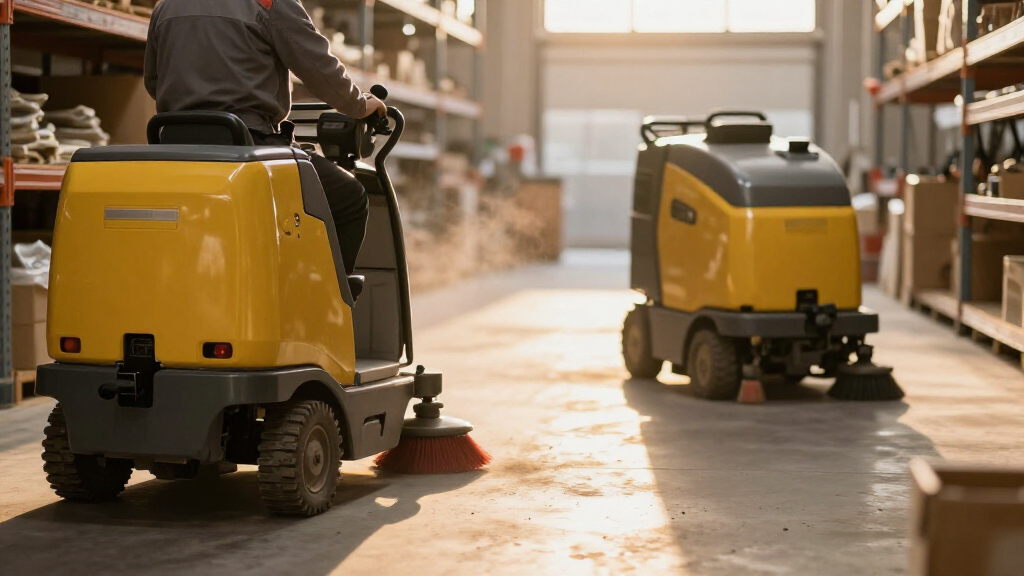
How We Picked
I compared these 15 sweepers by the decisions that separate ride-on and walk-behind ownership: cleaning width and stated coverage, operator effort, debris capacity, maneuverability, power source, and the demands of routine upkeep. I treated a wide path and ride-on operation as advantages for large, open floors, while compact size and manual simplicity mattered more for smaller areas and routes with frequent turns. I also considered whether listings gave enough information for buyers to judge fit, since a headline width alone does not reveal turning room, runtime, or service needs.
The order reflects intended use and the strength of the information available, not a claim that every model has been independently tested. The E8 leads as a broadly capable commercial ride-on; the manual and outdoor walk-behind models rank higher for buyers whose spaces do not justify a seated machine. Similar 49- to 51-inch ride-on listings follow as alternatives, with distinctions such as stated bin capacity and named product details guiding their relative roles. Sparse specifications are a limitation: buyers should verify dimensions, battery or fuel details, and parts support before choosing among lookalike listings.
Factors to Consider When Choosing Ride On Sweepers Vs Walk Behind Sweepers
I’d start with the shape of the job, not the machine’s biggest advertised number. These choices affect labor, storage, and how easily the operator can finish a route, so match the sweeper to the site’s actual traffic pattern.
Match the Sweeper to Route Length and Floor Area
Estimate how much floor the operator must cover in a normal shift, then note how often that route repeats. A ride-on sweeper can reduce walking and operator fatigue over long, open runs, but its larger footprint may slow work around shelving or parked equipment. A walk-behind machine can be easier to redirect through short routes and small workrooms. A common mistake is choosing by total facility area while ignoring how much of it is obstructed. If the floor is mostly open, a wide cleaning path may matter; if it is divided into tight zones, turning space can matter more. Sketching the route and measuring the narrowest aisle helps reveal which format can actually reach the floor that needs cleaning.
Account for Turning Space, Access, and Storage
Cleaning width is only one part of machine fit. Check the full machine dimensions, turning behavior, doorway clearance, elevator access, and the space available to park or charge it. Buyers sometimes focus on the brush width and miss that a ride-on may not pass through a doorway or make a tight turn without extra maneuvering. A walk-behind sweeper is often easier to store and reposition, though it can still be awkward on crowded routes. Compare the narrowest operating area with the machine’s actual specifications before ordering. Where those dimensions are not listed, treat the missing detail as a reason to get clarification.
Choose Capacity for the Debris You Collect
A larger dustbin can mean fewer trips to empty it, but bin volume alone does not tell you how long a sweeper can run between stops. Lightweight dust, leaves, and bulky debris fill a hopper differently, and a nearly full bin may affect handling. Think about the material collected, how often the floor is swept, and where the operator can empty the machine safely. For regular industrial cleanup, capacity can have a large effect on route interruptions. For a smaller shop, a smaller bin may be easier to manage and store. Check both capacity and emptying method instead of treating a large number as an automatic advantage.
Compare Power and Labor Across a Full Shift
Manual push sweepers avoid charging or refueling, but the operator supplies the effort on every pass. Battery-powered walk-behind machines reduce that pushing burden, while adding charging time and runtime limits to the work plan. Ride-on machines change the operator’s workload again, but buyers need to confirm how the unit is powered and what operating time or refueling needs apply. Do not assume a battery model can finish a route simply because its cleaning width seems adequate. Ask about runtime under working conditions, charge duration, and battery replacement. The best fit depends on both the size of the route and how many hours the sweeper must be ready each day.
Budget for Maintenance, Parts, and Downtime
Brushes, filters, batteries, and collection components all affect the cost and effort of keeping a sweeper in service. Before purchase, find out which parts are wear items, how often they need attention, and whether replacements are available for the exact model. A lower-complexity push sweeper may be easier to maintain, while a powered commercial machine can reduce labor across large routes but bring more service needs. A common buying mistake is comparing only the initial machine specification while ignoring the time spent clearing brushes or arranging repairs. Ask who handles warranty service and how routine parts can be ordered. Reliable support can matter more than a small difference in listed width when cleaning cannot wait.
Pay More Only When the Work Benefits
A ride-on format earns its place when it meaningfully cuts operator effort or route time across a large floor. On a small patio, shop, or room with frequent obstacles, that added size and complexity may not improve the job. Conversely, repeated manual sweeping over long warehouse routes can consume labor that a powered machine may save. Compare the likely work pattern, not just the machine category: a battery-powered walk-behind can bridge the gap for buyers who want powered sweeping but cannot use a ride-on. Consider who will operate the sweeper, how often, and for how long. If the workload is occasional, simplicity may be worth more than added capacity.
Frequently Asked Questions
When does a ride-on sweeper make more sense than a walk-behind?
I’d favor a ride-on when operators regularly cover large, mostly open floors and walking the route would take substantial time or effort. Its broad cleaning path can help reduce passes, while the seated position can be easier over long shifts. The tradeoff is a larger machine that needs suitable aisles, access, storage, and service support. For short routes with frequent turns, a walk-behind can be simpler to maneuver and put away. Compare the actual route and operator hours before deciding that a ride-on is necessary.
Can a manual walk-behind sweeper handle a warehouse?
It can handle selected warehouse tasks, especially short routes, spot cleanup, or areas where a powered machine cannot turn easily. The constraint is operator effort and time: long aisles repeated across a large floor can make manual sweeping demanding. A wide manual unit may cover more per pass, but it still depends on the operator pushing it. Consider whether the warehouse needs daily full-floor sweeping or occasional cleanup in defined zones. For extensive daily coverage, compare powered walk-behind and ride-on options as well.
Is a wider cleaning path always the better choice?
No. A wider path can reduce passes on an open floor, but it can be difficult to use around narrow aisles, close-set equipment, and doorways. It may also make storage and transport more demanding. The listed 49- to 51-inch ride-on options in this roundup suit broad routes better than cramped work areas, while narrower or walk-behind formats can fit tighter jobs. Check the machine’s overall dimensions and turning space, not just the brush width. A width that fits the route is more useful than the widest figure on a product page.
What should I verify before choosing a battery-powered walk-behind sweeper?
Confirm working runtime, charge duration, battery replacement availability, and whether the machine can complete your route between charges. The 41.3-inch battery-powered model in this lineup offers a middle ground between a manual push unit and a ride-on, but the headline width does not answer how long it can operate. Ask whether runtime changes with debris load or surface conditions. Check where the unit can charge and whether a spare battery is available if the sweeper must stay in service. Those details help prevent a machine that fits the floor but not the work schedule.
How should I compare ride-on models with similar stated coverage?
Start by checking that each listing describes coverage in the same way; a stated area per hour may depend on assumed speed and conditions. Then compare hopper capacity, full machine dimensions, power source, controls, and access to replacement parts. Similar brush widths do not guarantee similar maneuverability or operating time. This roundup includes several ride-on models with close headline widths, so those missing practical details can make a bigger difference than a small specification gap. Ask the seller to confirm any detail that is absent before you rely on it for a purchase decision.
Conclusion
I’d choose the E8 51-Inch Ride-On Commercial Floor Sweeper as the best overall option for buyers who need broad commercial coverage and have open routes. For a simpler, small-area choice, the VEVOR manual walk-behind is my value pick, while the Kärcher S 4 Twin makes the most sense for beginners handling lighter outdoor cleanup. Buyers seeking a powered walk-behind format should look at the 41.3-inch battery-powered model and confirm runtime and charging details first. For larger industrial routes, compare the ride-on models by capacity, dimensions, service support, and confirmed operating details; the Liberty LS-WS1400 stands out by its listed 120-liter capacity. The right choice comes down to how much floor you sweep, how tight the route is, and how much operator effort the job can support.
Fall Picks
fall essentials
As an affiliate, we earn on qualifying purchases.